Why Every Frontier AI Failed Humanoid Tasks in 5,699 Trials
RoboColosseum evaluated 8 AI models across 5,699 real-world robot trials. Every model failed humanoid manipulation tasks, revealing key physical AI limits.

On November 2, 2026, a research consortium spanning the National University of Singapore, Stanford University, and the University of Washington published the RoboColosseum research paper, introducing a distributed evaluation framework for real-world robotics. Operating across 124 physical sites in five countries, the benchmark recorded 5,699 pairwise comparisons to test how artificial intelligence handles physical tasks outside controlled laboratory settings.
Social media feeds remain saturated with viral video clips showcasing bipedal robots executing acrobatic flips and warehouse maneuvers under tailored conditions. The RoboColosseum evaluation evaluated eight leading artificial intelligence systems against unscripted, real-world friction. The roster included five specialized Vision-Language-Action policies alongside three frontier multimodal agents: GPT-6 Astra, Claude Opus 5.5, and Grok 4.7. Academic teams from Oxford University, the Allen Institute for AI, Hugging Face, and BitRobot structured standardized protocols to test these systems across residences, offices, and industrial canteens.
Moving from synthetic simulation environments into uncalibrated physical rooms exposed fundamental operational barriers that digital reasoning benchmarks and synthetic simulation runs previously obscured.
The most striking empirical finding emerged on the bipedal humanoid platform, the Unitree G1. Across five distinct manipulation tasks, every single evaluated model failed to achieve a single complete run. The resulting task completion rate across the entire humanoid trial suite was exactly zero percent.
Zero Completions and the Diagnostic Reality of Humanoid Tasks
The total failure of all eight models to complete the Unitree G1 tasks highlights the chasm between digital semantic planning and closed-loop motor control. While frontier models correctly identified target objects and parsed spatial instructions, continuous physical execution broke down when navigating dynamic balance, hand-eye coordination, and real-time contact friction.
Despite the zero percent completion rate, the researchers documented that average partial progress reached between 13.3 percent and 23.2 percent across the policy suite. Models routinely initiated the required sequence, approaching target items and closing mechanical grippers during preliminary phases. Failure points accumulated rapidly during subsequent motor stages, where compounding positional errors disrupted the kinematic chain. These failures demonstrate how minor perceptual misalignments in real-world lighting cascade into terminal mechanical aborts.
Distinguishing between partial motor trajectory progress and final task completion establishes a necessary diagnostic standard for systems engineering, much like previous studies on the Pollen Robotics Reachy Mini tracked localized hardware limits.
Conventional binary evaluation metrics categorizing trials strictly as success or failure discard granular engineering telemetry. A robot policy that achieves twenty percent progress before mechanical failure provides vital calibration data regarding gripper trajectory and velocity thresholds. In the authors' explicit phrasing, "Measuring partial progress reveals differences that task success alone misses."
Hardware Divergence and the Collapse of Universal Policy Rankings
RoboColosseum evaluated systems across four distinct mechanical embodiments: the open-source SO-101 single arm, the Franka research arm, the Bimanual-YAM dual-arm station, and the Unitree G1 humanoid. The experimental data revealed that policy competence does not generalize uniformly across disparate physical chassis.
Statistical analysis across embodiment-specific task suites produced a Kendall concordance coefficient of W = 0.24. This low correlation confirms that a policy ranking established on one robotic arm provides virtually zero predictive power for another. Models that demonstrated stable grasping on the Franka manipulator dropped sharply when deployed on the compliant joints of the lower-cost SO-101. The empirical findings dismantle the industry assumption that a single foundational model can control arbitrary robotic embodiments without tailored hardware co-design.
Physical machine intelligence remains fundamentally constrained by the mechanical resonance, camera placement, and actuator torque profiles inherent to each specific physical chassis.
This hardware divergence became pronounced during the Fine-tune Track, where models adapted to specific tasks. NVIDIA GR00T N1.7 secured top placement on the budget SO-101 arm after receiving one hundred human demonstrations per task. Conversely, the open-weights π0.5 policy led performance on both the Franka arm and the coordinated Bimanual-YAM station under the same training regimen.
Why Zero-Shot Arena Scores Collapse Under Physical Adaptation
The benchmark architecture separated trials into an unadapted Open Track and a standardized Fine-tune Track. This structural division directly compared out-of-the-box reasoning capabilities against focused task adaptation in matched local scenes.
In the Open Track, frontier multimodal agents including GPT-6 Astra, Claude Opus 5.5, and Grok 4.7 rivaled specialized robotics models in blinded comparisons. While these general-purpose reasoning engines excelled at understanding complex scenes, their zero-shot standing failed to predict performance following fine-tuning. The researchers recorded substantial rank reversals across all three hardware embodiments shared between the two tracks. Policies that appeared dominant in zero-shot evaluations frequently stalled when tasked with mastering specialized twenty-step physical routines.
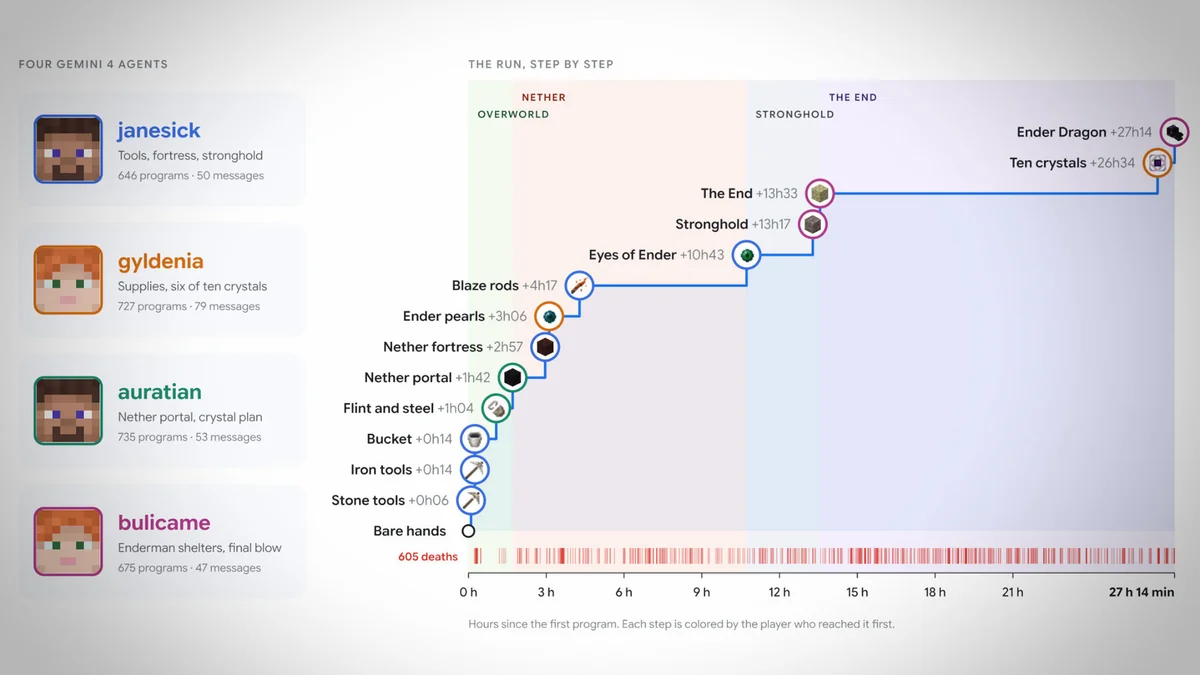
Digital prompt comprehension and semantic visual parsing do not translate into sample-efficient policy adaptation, echoing how digital agents explored in Gemini 4 Argon in Minecraft hit mechanical constraints in embodied execution.
The Fine-tune Track provided each architecture with exactly one hundred demonstrations per task across twenty standardized challenges. This identical demonstration budget proved that model capacity alone cannot compensate for architectural rigidity in trajectory generation. Systems lacking specialized action-head representations struggled to translate visual goals into smooth continuous torque commands.
Distributed Testing Logistics and the Economics of Physical Grounding
Executing trials across 124 real-world sites tackles the historical reproducibility crisis that has long bottlenecked academic robotics. Gathering physical data across private residences, corporate lobbies, and commercial food courts forced models to confront variable ambient lighting and uncalibrated surfaces.
Operating under the RoboColosseum project leaderboard, the consortium deployed fleets across Singapore, China, the United States, the United Kingdom, and Malaysia. The organizers committed to providing 10,000 hours of free physical evaluation time to academic institutions and independent researchers. This distributed infrastructure allows software developers without hardware budgets to validate model checkpoints on real machinery. Removing the capital barrier of physical robot ownership shifts robotics benchmarking toward the decentralized testing models common in software engineering.
Standardized physical testing protocols replace marketing-driven promotional reels with continuous, audit-grade performance verification conducted directly across unpredictable, everyday environments.
Advancing autonomous physical manipulation requires abandoning binary success metrics in favor of granular trajectory telemetry and open error registries. Roboticists now face the technical task of resolving high-latency inference loops and hardware-specific mechanical compliance. Embodied machine intelligence ultimately advances through rigorous, reproducible contact with physical reality rather than ungrounded parameter expansion.
Was this article helpful?
Your feedback helps our editorial team refine reporting depth and accuracy.
Related Articles
Reachy Mini Gets Wheels: What the Hoverboard, App and NFC Hats Change (and What They Don't)
Pollen Robotics announced wheels, a mobile app, and NFC hats for Reachy Mini Wireless, introducing hardware modularity alongside delivery timeline divergences.

Gemini 4 Argon: Google DeepMind Agents Beat Minecraft Across 27 Hours and 1.35 Billion Tokens
Four Gemini 4 Argon agents completed Minecraft end-to-end without human intervention, but the 27-hour run consumed 1.35 billion input tokens and suffered 605 in-game deaths.
Google Antigravity Migrates 40-Year-Old Scientific Fortran to Rust in 59 Minutes
Google Antigravity migrated a 174K-line Fortran ocean model to safe Rust in 59 minutes, uncovering six legacy bugs and achieving 1.88x faster simulations.