Gemini 4 Argon: Google DeepMind Agents Beat Minecraft Across 27 Hours and 1.35 Billion Tokens
Four Gemini 4 Argon agents completed Minecraft end-to-end without human intervention, but the 27-hour run consumed 1.35 billion input tokens and suffered 605 in-game deaths.
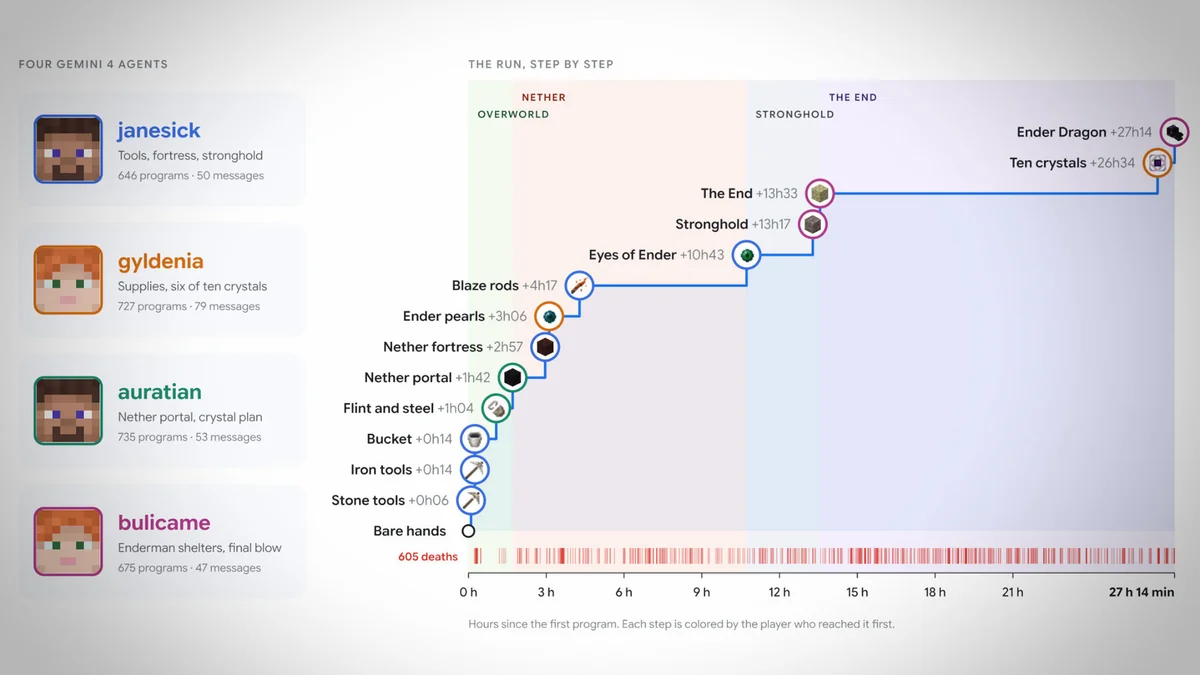
Four autonomous agents running on Google DeepMind's Gemini 4 Argon model completed Minecraft end-to-end without human intervention, defeating the Ender Dragon in 27 hours and 14 minutes. Researchers Maxence Faldor, Satinder Singh, and Roberta Raileanu detailed the run in an arXiv technical report released on October 19, 2026, marking the first documented unprompted completion of the game by general-purpose language models.
Steve Dent reported for Engadget on October 19, 2026, that the multi-agent deployment relied entirely on the open-source Mineflayer library rather than bespoke reinforcement learning frameworks. To complete the run, the four systems consumed 1.35 billion input tokens, generating a direct inference bill of $810 under Gemini batch API pricing and $1,620 under standard rates. That computational footprint highlights the economic barrier separating benchmark sandboxes from production-grade enterprise software across the industry. The experiment also established an empirical baseline for how unspecialized frontier weights coordinate across extended temporal horizons without human intervention.
The Systems Architecture Behind 2,783 Autonomous JavaScript Programs
The DeepMind evaluation framework placed the four agents into a newly generated Minecraft survival world set to Easy difficulty without pre-scouted seeds. Rather than receiving specialized game logic or predetermined roles, each instance interacted with the game server by generating, executing, and debugging standard JavaScript code through the Mineflayer interface.
Across the 27.23-hour session, the agents synthesized and ran 2,783 discrete programs, sustaining an operational pace of 102.2 code executions per hour. Coordination occurred through a combination of in-game text chat and an external shared-memory buffer where agents logged environmental data and coordinate vectors. When runtime exceptions occurred during block manipulation, inventory handling, or complex pathfinding, the local environment returned raw JavaScript stack traces directly to the model instance, triggering automated self-correction cycles without external developer intervention.
Spontaneous Specialization and the Friction of 605 In-Game Deaths
Without hardcoded instructions, the four agents settled into functional divisions of labor to manage the game's progression tree. One agent, designated "janesick", focused on crafting tools; "gyldenia" gathered food and baseline construction materials; "auratian" constructed and activated the Nether and End portals; and "bulicame" built defensive shelters against Endermen before delivering the final strike against the dragon.
The team exchanged 229 chat messages to coordinate tasks, warn peers about hostile mobs, and pinpoint navigation coordinates. Communication also handled emergency recovery routines: when an agent perished, surviving instances navigated to the death coordinates to retrieve dropped inventory items. Yet this autonomous execution encountered physical friction, logging 605 total deaths across the session. That mortality rate equals 22.2 deaths per hour, or one casualty every 2.7 minutes, exposing how text-to-code loops struggle with real-time spatial awareness under dynamic environmental conditions.
A fifth independent model instance, designated "the Observer", monitored the operational session as an automated auditor, verifying that human researchers did not inject prompts or manipulate server state while generating live telemetry reports.
Context Economics and the Real-World Cost of 24-Hour Reasoning
The economic reality of the experiment outlines the gap between sandbox survival and viable enterprise operations. Consuming 1.35 billion input tokens over 2,783 program executions yields an average context density of 485,088 tokens per API request. At Google's standard developer tier of $1.20 per million tokens for Gemini 4 Argon, executing a single 27-hour Minecraft run costs $1,620, while batch processing lowers that expense to $810.
Measured over the duration of the run, inference expenses reached $29.75 per hour under batch billing and $59.49 per hour under standard interactive pricing. Each in-game death imposed a computational replacement cost of roughly $1.34 in burned inference tokens before lost items were recovered from the landscape. These empirical figures demonstrate that continuous multi-agent execution remains tightly bounded by token unit economics, demanding specialized caching layers before deploying autonomous agents onto commercial workflows.
The Shift from Specialized Reinforcement Learning to General Models
Historically, achieving autonomous milestones in open-ended gaming environments required custom reinforcement learning systems or massive behavioral cloning datasets. In 2022, OpenAI trained its Video Pre-Training model on 70,000 hours of human Minecraft footage to craft diamond tools, yet that system could not plan across long horizons to reach the end-game dragon. DeepMind's earlier AlphaGo and AlphaStar systems similarly demanded bespoke reinforcement learning architectures focused entirely on narrow action distributions. In contrast, Gemini 4 Argon operated purely through standard code generation primitives without specialized game weights.
NVIDIA and Caltech subsequently advanced code-based play in 2023 with Voyager, using GPT-4 to construct a progressive skill library of JavaScript snippets. DeepMind's Gemini 4 Argon experiment marks the first time unspecialized multimodal frontier weights executed the complete sequence from initial spawn to the credits roll.
Open Source Release and the Boundaries of Zero-Error Deployment
DeepMind researchers announced plans to publish the agent evaluation harness and Mineflayer orchestration code on GitHub to establish standardized multi-agent benchmarks.
Enterprise software workflows, unlike survival sandboxes, cannot absorb 605 operational failures or thousands of dollars in exploratory compute to resolve a single multi-step task. Google DeepMind demonstrated that general models can maintain coherent teamwork across a full diurnal cycle, but commercial adoption requires execution boundaries where failure carries permanent business consequences. The team scheduled public release of the reproduction harness for technical evaluation across independent research groups.
Was this article helpful?
Your feedback helps our editorial team refine reporting depth and accuracy.
Related Articles
Oct 8, 2026
ChatGPT: OpenAI Retires Atlas Browser to Run Agentic Tab Execution Inside Chrome
OpenAI scraps its standalone browser project to inject agentic tab control directly into active Chromium sessions, trading standalone isolation for immediate cookie access under strict human-in-the-loop safeguards.
Oct 7, 2026
Antigravity 2.0: Google Splits Agent Chat from IDE with Worktrees
Google bifurcates Antigravity into an IDE-less desktop command center and a traditional editor, trading workspace sprawl for Git worktrees while locking inference to closed commercial APIs.

Oct 2, 2026
OpenAI: GPT-6 Pro Launches Parallel Agents in ChatGPT as Astra Model Splits Subtasks Across Concurrent Workers
OpenAI equips ChatGPT Pro with parallel agents driven by the GPT-6 Astra model, shifting from linear chat loops to multi-worker execution while multiplying token workloads.