ChatGPT: OpenAI Retires Atlas Browser to Run Agentic Tab Execution Inside Chrome
OpenAI scraps its standalone browser project to inject agentic tab control directly into active Chromium sessions, trading standalone isolation for immediate cookie access under strict human-in-the-loop safeguards.
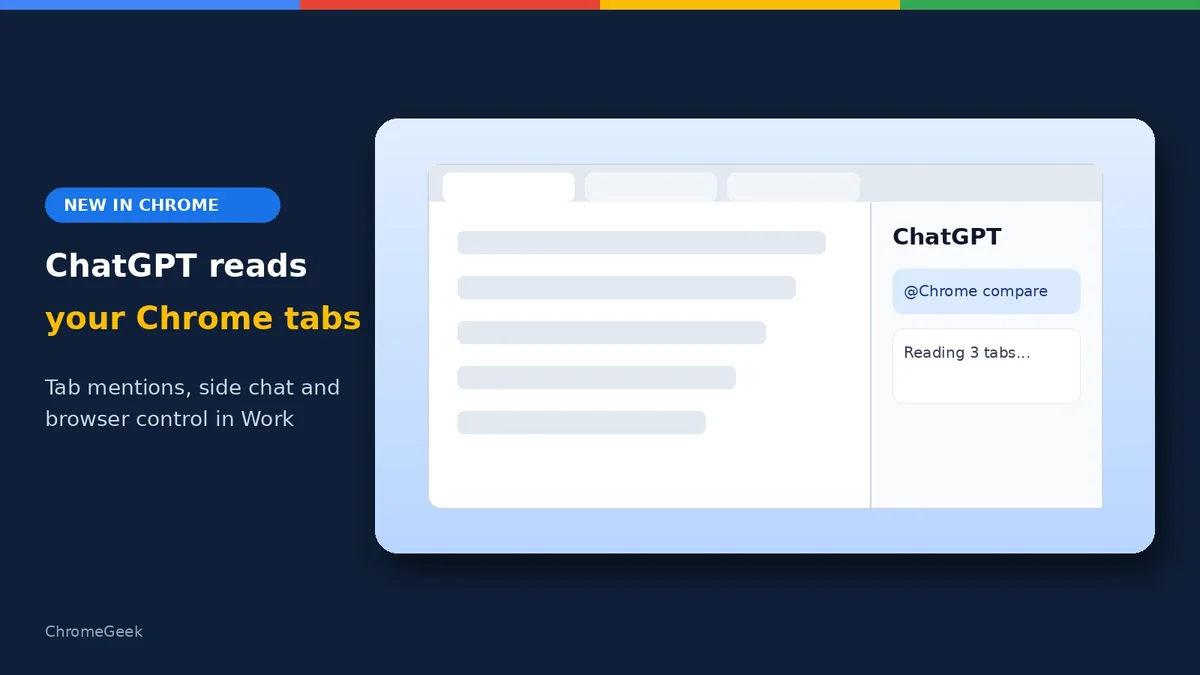
OpenAI officially retired its standalone desktop browser project, code-named ChatGPT Atlas, shifting its autonomous web agents directly into the existing Google Chrome extension ecosystem, The Verge reported on October 15, 2026. The transition terminates the company's attempt to build an isolated, Chromium-based destination client in favor of embedding agentic workflows into active browser sessions where enterprise users already spend their working hours.
Search interest for the discontinued Atlas initiative jumped 600% on global tracking indexes as technical teams dissected the shift from a separate browser environment to an in-session extension running distinct Chat and Work operating modes.
Building an independent desktop application required end users to rebuild their digital workspaces from scratch, introducing friction that enterprise software vendors routinely struggle to overcome. Clean-room browser forks consume between 800 megabytes and 1.5 gigabytes of resident memory per isolated profile while requiring duplicate credential vaults. Rather than fighting browser-level network effects and hardware memory constraints, the updated ChatGPT extension injects multi-tab context parsing and automated Document Object Model actuation directly into established Chromium runtimes.
The Retreat From Standalone Browsers: Why Atlas Yielded to Extension Runtimes
Dedicated artificial intelligence browsers face a persistent operational roadblock: authentication friction across enterprise identity providers. Standalone clients isolate web traffic inside clean-room containers, forcing corporate workers to re-authenticate across Single Sign-On gateways, solve multi-factor verification challenges on every session reset, and transfer stored password vaults into an unproven local shell. Corporate security policies frequently ban unauthorized secondary browsers, preventing engineers and knowledge workers from accessing internal web applications behind zero-trust network perimeters.
By abandoning the isolated container model of Atlas, OpenAI sidestepped this bootstrap dilemma entirely. The updated Chrome extension operates directly atop the active user profile, inheriting live session cookies, authenticated tokens, and local cache layers for mission-critical software platforms including Gmail, Salesforce, and LinkedIn. Instead of handling raw enterprise credentials across external proxy servers, the extension executes instructions against pre-authenticated Document Object Model trees. This architectural compromise dramatically accelerates deployment cycles, yet it transfers the underlying security perimeter from network firewalls directly to in-tab execution guardrails.
Dual-Mode Architecture: Separating Context Ingestion From DOM Actuation
The extension architecture partitions browser engagement into two explicit operational profiles: Chat mode and Work mode.
Chat mode functions as a passive contextual reader across open tabs. By invoking the @Chrome handle inside desktop or web prompts, users allow the underlying model to parse and summarize text across concurrent viewports without manual clipboard transfers. Instead of ingesting raw HTML payloads cluttered with inline styling and tracking scripts, the extension serializes the browser Accessibility Object Model into structured semantic text blocks. This compression technique prevents context window saturation when synthesizing technical specifications, API documentation, or vendor pricing schedules across five or ten simultaneous tabs.
Work mode, by contrast, activates autonomous agentic actuation under the Computer Use runtime configured inside the ChatGPT desktop application settings. In this state, the agent translates high-level natural language instructions into programmatic browser interactions, synthesizing form inputs, organizing disorganized tab groups by topic, and downloading requested asset packages. The runtime listens for asynchronous Document Object Model mutation events to verify that client-side dynamic frameworks have finished rendering before attempting DOM dispatches.
Compatibility spans five major Chromium platforms, encompassing Google Chrome, Microsoft Edge, Brave, Opera, and Vivaldi, though Opera remains restricted from rendering the persistent sidebar interface. The extension coordinates execution via background script channels, leaving the primary operating system cursor unconstrained so operators can continue parallel terminal or editor tasks.
The Security Trade-Off: In-Session Execution and the Human-in-the-Loop Barrier
Executing automated routines within authenticated tabs introduces severe security exposures that isolated sandbox architectures traditionally mitigate. Malicious third-party web pages can harbor indirect prompt injection payloads hidden within CSS metadata, invisible canvas layers, or disguised Document Object Model attributes designed to hijack the agent's active session. Because the model operates with the full session privileges of the logged-in operator, an unsanctioned command could theoretically exfiltrate proprietary CRM records, trigger financial wire instructions, or issue internal email communications without triggering standard perimeter alarms.
To counter unauthorized state transitions, OpenAI embedded an explicit human-in-the-loop interruption mechanism into the Work mode execution engine.
When conducting structured tasks such as filling conference registrations or enterprise vendor agreements from source briefs, the system systematically halts execution immediately before the final submission button. The human operator retains responsibility for auditing pre-populated input fields and authorizing irreversible write operations.
The Chromium Paradox: Autonomy Under Competitor Governance
Embedding enterprise agents inside Chrome delivers distribution velocity while tethering OpenAI to runtime constraints established by its primary market rival. The Alphabet subsidiary controls the underlying Blink rendering engine, dictates extension capability ceilings through Manifest V3 service worker lifecycles, and deploys its own native Gemini Auto Browse capabilities within the same browser real estate. Every background script execution budget, cross-origin communication rule, and storage quota affecting the ChatGPT extension remains subject to unilateral revision by Google's Chromium steering committee. IT administrators managing Chrome Enterprise policies now face the delicate balance of whitelisting broad host permissions while restricting automated data scraping across sensitive internal portals.
Enterprise infrastructure teams evaluating agentic browser automation will measure the practical utility of immediate cookie inheritance against the ongoing governance obligations of monitoring client-side script execution.
Was this article helpful?
Your feedback helps our editorial team refine reporting depth and accuracy.
Related Articles
Oct 7, 2026
Antigravity 2.0: Google Splits Agent Chat from IDE with Worktrees
Google bifurcates Antigravity into an IDE-less desktop command center and a traditional editor, trading workspace sprawl for Git worktrees while locking inference to closed commercial APIs.

Oct 2, 2026
OpenAI: GPT-6 Pro Launches Parallel Agents in ChatGPT as Astra Model Splits Subtasks Across Concurrent Workers
OpenAI equips ChatGPT Pro with parallel agents driven by the GPT-6 Astra model, shifting from linear chat loops to multi-worker execution while multiplying token workloads.
Oct 1, 2026
Google AI Pro Trials: Antigravity Locks Out Gemini 4 Argon as Inference Economics Constrain Hardware Bundles
Hardware bundles tout multi-month AI Pro subscriptions, but Antigravity locks promotional accounts out of Gemini 4 Argon as agentic code generation exposes the unsustainable cost of free inference.