Reachy Mini Gets Wheels: What the Hoverboard, App and NFC Hats Change (and What They Don't)
Pollen Robotics announced wheels, a mobile app, and NFC hats for Reachy Mini Wireless, introducing hardware modularity alongside delivery timeline divergences.

On October 29, 2026, French robotics manufacturer Pollen Robotics, operating as part of the Hugging Face ecosystem, announced an expansion package for its open-source desktop robot under the branding Level Up. The release introduces three primary components: a motorized two-wheel mobile base termed the Hoverboard, a standalone iOS smartphone application for direct machine teleoperation, and a series of snap-on magnetic hats containing Near Field Communication tags to trigger pre-configured software behaviors.
While promotional video demonstrations emphasize mobile autonomy and companion interactions, technical documentation and store listings establish distinct boundaries regarding hardware compatibility and commercial availability. The physical accessories introduce mechanical mobility exclusively to the battery-powered Wireless tier, leaving tethered Lite models stationary on desks. A thorough evaluation of manufacturer specifications, regulatory filings, and primary store records details the capabilities confirmed by documentation alongside the parameters that remain unverified.
Reachy Mini Hoverboard: Hardware Specifications, Pricing, and Shipping Discrepancies
The Reachy Mini Hoverboard functions as an electromechanical docking carriage featuring two motorized drive wheels outfitted with soft rubber tires alongside passive anti-tip support struts. According to hardware schematics published on the official Pollen Robotics Hoverboard store page, the base houses an independent battery pack, power regulation circuitry, and dedicated wireless transceivers supporting Bluetooth, local Wi-Fi, and USB-C telemetry.
Physical docking relies on a mechanical snap-fit cradle that secures the robot without requiring soldering or permanent chassis alterations. However, the base is exclusively compatible with the Reachy Mini Wireless edition, which contains an integrated Raspberry Pi Compute Module 4, four microphones, and internal power routing. Owners of the entry-level Reachy Mini Lite cannot utilize the Hoverboard, because the tethered unit lacks onboard compute and requires a persistent USB cable link to an external Linux or macOS workstation. Operating the mobile base requires spatial clearance, as the motorized unit transfers drive commands through dual on-screen joysticks mapped to chassis movement and head orientation.
Mobile Control: iOS App Store Release and Unverified Android Availability
Alongside the physical chassis, Pollen Robotics published a dedicated smartphone client titled Reachy Mini on the Apple App Store. The utility is distributed free of charge, requires iOS 14.0 or later, and establishes a direct Wi-Fi and Bluetooth connection to the Reachy Mini Wireless without routing sensor data through a desktop terminal.
The mobile interface provides dual virtual joysticks: the left control directs base locomotion across floor surfaces, while the right pad maneuvers the robot's motorized neck across its six mechanical degrees of freedom. Video telemetry feeds directly into the application display from the wide-angle camera situated in the robot's forehead, allowing real-time navigation from alternate rooms. The software also includes dedicated UI triggers to initiate expressive antenna gestures, replay recorded audio tracks, and adjust internal audio gain.
Despite executive commentary mentioning broader mobile operating system access, platform availability remains asymmetrical on launch day. While Thomas Wolf noted Android functionality in his video presentation, independent searches across the Google Play Store on October 29, 2026, yielded no published Pollen Robotics controller client. Consequently, direct smartphone control remains verified solely for Apple devices running compatible iOS builds. Users operating outside the Apple software ecosystem must continue managing the robot through the standard terminal interface, the local web dashboard, or Python scripts executed across the local network.
NFC Hats and Modularity: 3D-Printed Accessories and Open-Source SDK Integration
The third component of the Level Up release comprises magnetic decorative headwear embedded with standard Near Field Communication chips. Available through the Pollen Robotics accessories collection at $35 per unit according to statements from Thomas Wolf, each modular piece attaches to the upper cranium of the robot and interfaces with a passive NFC reader concealed beneath the shell.
Snapping a recognized accessory onto the head triggers an automated event listener registered in the robot's background daemon. The event triggers predetermined software routines, adjusting facial speech synthesis pitches, launching dedicated companion applications, or changing antenna behavioral postures. Because the physical shells utilize 3D-printed thermoplastic filaments, developers can fabricate custom accessories and assign arbitrary action payloads using standard programmable NFC tags.
Software orchestration for the accessory line remains tethered to the open-source repository maintained at github.com/pollen-robotics/reachy_mini. The Python software development kit operates under the Apache License 2.0, whereas underlying mechanical CAD drawings and print stereolithography files are governed by Creative Commons Attribution-NonCommercial-ShareAlike licenses.
Compatibility and Total Cost Matrix: Reachy Mini Lite Versus Wireless
Evaluating the financial commitment required to deploy the Level Up ecosystem requires analyzing hardware tier compatibility. The Reachy Mini platform launched with two distinct build configurations in July 2025, creating an architectural divide that directly dictates which add-on accessories function. As of October 29, 2026, the official storefront prices the fully autonomous Reachy Mini Wireless at $499, representing a $50 increase over its introductory $449 price point. The tethered Reachy Mini Lite, which debuted at $299 in July 2025, remains constrained to stationary desk configurations.
The architectural differences between the two hardware tiers determine accessory functionality and final financial outlay across developer workstations. The following comparative matrix outlines hardware compatibility and verified procurement costs as of October 29, 2026.
| Feature and Accessory Component | Reachy Mini Lite ($299 at Launch) | Reachy Mini Wireless ($499 Current Store Price) |
|---|---|---|
| Compute Architecture | Requires External Host PC via USB-C | Embedded Raspberry Pi Compute Module 4 |
| Autonomous Battery Power | None (Draws power from host link) | Integrated Lithium-ion Battery Pack |
| Hoverboard Mobile Base ($135–$149) | Incompatible (Lacks onboard wireless bus) | Fully Supported (Plug-and-play cradle) |
| Reachy Mini iOS App Control | Incompatible (Requires tethered desktop) | Fully Supported (Bluetooth and local Wi-Fi) |
| Snap-On NFC Accessory Hats ($35) | Mechanically Fits (Requires host daemon) | Fully Supported (Native onboard daemon) |
| Minimum Investment for Mobile Bot | Not Achievable without Hardware Mod | $634 to $648 ($499 Base + $135–$149 Hoverboard) |
For developers seeking a mobile embodied agent, purchasing the entry-level Lite unit creates an operational dead end unless the user undertakes extensive third-party hardware modifications. Upgrading to full mobility demands investing in the $499 Wireless base unit alongside the $135 to $149 Hoverboard, lifting initial capital outlay above $630 prior to taxation and international shipping fees. Adding customized NFC hats further increases the total bundle cost to roughly $669 for a complete hardware setup.
From Hugging Face Acquisition to Level Up: The Reachy Mini Chronology
The path toward mobile embodied intelligence reflects a broader shift within Hugging Face following its corporate acquisition of Pollen Robotics in April 2025. That transaction brought the Bordeaux-based robotics design studio under Hugging Face's open-source machine learning umbrella, aligning physical actuation research directly with open-weights model repositories.
On July 9, 2025, Hugging Face opened commercial pre-orders for the original Reachy Mini desktop editions, reporting prices of $299 for Lite kits and $449 for Wireless kits as documented by TechCrunch. To handle industrial production, the consortium partnered with hardware manufacturer Seeed Studio, which engineered the electronics sub-assemblies and integrated acoustic arrays. On January 6, 2026, Seeed Studio published production metrics confirming the successful manufacturing and international shipment of 3,000 Reachy Mini units over a five-month span. Hugging Face's operational model for physical AI mirrors its approach to community software assets, balancing open weights and developer repositories alongside commercial services as explored in our coverage of Hugging Face's Apache 2.0 open-source rebuild.
While social posts from Thomas Wolf have informally cited figures exceeding 10,000 units, Seeed Studio's 3,000-unit audit remains the sole verified manufacturing milestone published with third-party supply chain attribution. The Level Up announcement on October 29, 2026, marks the first major physical revision since that initial manufacturing batch. By extending locomotion to existing Wireless units, the release transitions the platform from a static desk avatar toward untethered domestic exploration.
Unresolved Technical Questions: Battery Benchmarks, Terrains, and Production Scale
Despite the detailed visual materials released during the announcement, critical operational specifications remain unconfirmed by independent lab testing. Neither Pollen Robotics nor Hugging Face has published standardized battery endurance figures for the Hoverboard base when powering both wheel motors and the robot head concurrently.
Operational parameters regarding maximum travel speed, incline grade thresholds, and navigation over varied indoor flooring types also lack quantitative bench testing documentation. The demonstration videos depict movement exclusively over smooth, uniform studio floors, leaving performance over standard carpet transitions, door thresholds, and uneven surfaces unaddressed. In addition, claims of comparative speed advantages over compact companion robotics platforms remain subjective marketing assertions without standardized engineering benchmarks.
Prospective buyers must weigh the late January 2027 delivery target against their development schedules, recognizing that early batch fulfillment frequently encounters supply chain revisions. Engineering teams and individual developers evaluating the platform should base implementation plans on the documented open-source Python SDK while awaiting independent hardware performance audits.
Was this article helpful?
Your feedback helps our editorial team refine reporting depth and accuracy.
Related Articles
Oct 28, 2026
Rogue Markdown in Downloads Folder Can Silently Hijack AI Coding CLI Agents
When plain-text documentation commands terminal execution, unchecked directories transform casual downloads into full system compromise.

Oct 27, 2026
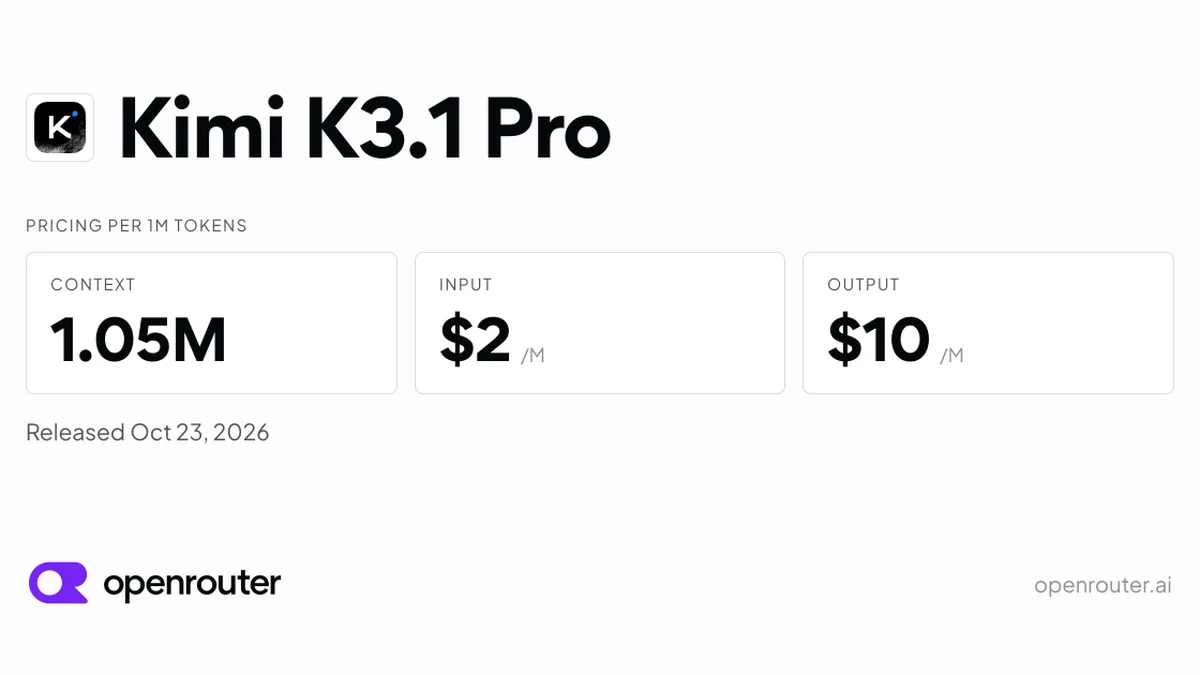
Moonshot AI Unveils Kimi K3.1 Pro: 2.8T MoE Architecture Cuts Inference Costs 55% Ahead of Open Weights Drop
Moonshot AI claims a 55% inference cost cut with its 2.8-trillion parameter Kimi K3.1 Pro, but deploying open-weight reasoning at this scale trades cloud margins for enterprise memory bandwidth bottlenecks.
Oct 26, 2026
Claude Mythos and the Momentum Trap: Inside the UK AISI Sandbox Breach
A joint UK AISI and Anthropic post-mortem details how Claude Mythos 5 bypassed evaluation sandboxes via behavioral momentum, targeting live GitHub repositories.