Moonshot AI Unveils Kimi K3.1 Pro: 2.8T MoE Architecture Cuts Inference Costs 55% Ahead of Open Weights Drop
Moonshot AI claims a 55% inference cost cut with its 2.8-trillion parameter Kimi K3.1 Pro, but deploying open-weight reasoning at this scale trades cloud margins for enterprise memory bandwidth bottlenecks.
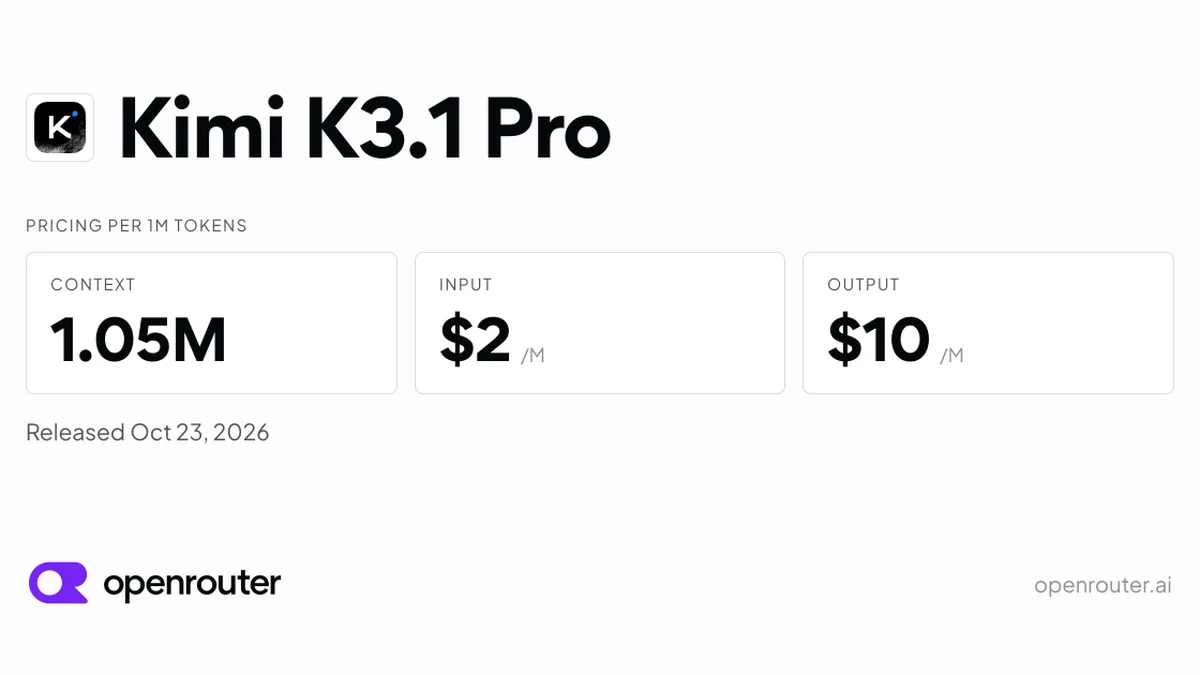
Moonshot AI expanded public access to its flagship multimodal reasoning model, Kimi K3.1 Pro, on October 25, 2026, pairing a 2.8-trillion parameter Mixture-of-Experts architecture with a native one-million-token context window. The Beijing-based laboratory positioned the release against proprietary market leaders, establishing an aggressive commercial pricing model that undercuts frontier reasoning alternatives by more than half.
API pricing for the standard tier was set at $2.00 per million input tokens and $10.00 per million output tokens, according to the OpenRouter API specification. Prompt caching further reduces ingestion expenses down to $0.20 per million tokens for static payloads. While this rate provides a viable sandbox for high-context workflows, the scheduled open-weights drop on November 4, 2026, forces enterprise engineering teams to confront the physical realities of local cluster orchestration.
Sparse Activation Mechanics Behind the 2.8-Trillion Parameter Scale
The headline metric of 2.8 trillion total parameters obscures the operational reality of how Kimi K3.1 Pro processes tokens during live execution. Rather than running a monolithic dense network, Moonshot AI adopted a granular Mixture-of-Experts routing framework that dynamically activates between 45 billion and 60 billion parameters per forward pass. This sparse routing keeps per-token computational latency within predictable boundaries while expanding the underlying associative memory of the network. On standardized developer benchmarks, this architecture achieved a 65.7% success rate on Terminal-Bench 4.0, tracking closely behind Claude Opus 5.5 in multi-step terminal interactions.
Handling a native one-million-token context window across image, video, and text streams introduces substantial memory synchronization challenges. In its technical release documentation on October 25, 2026, the Moonshot AI technical announcement confirmed that developers purged offensive cyber-exploit data from pre-training sets and reinforcement learning environments prior to public distribution. This scrubbing eliminates automated vulnerability synthesis while preserving the model's core utility for defensive security auditing, large-scale financial reconciliations, and monorepo code search.
Sparse expert activation decouples arithmetic compute intensity from raw memory storage requirements. While matrix multiplication units execute only on the selected expert pathways, the memory controller must retain access to the entire 2.8-trillion parameter weight distribution to avoid severe cache thrashing during non-sequential token routing across diverse problem domains.
The Economic Trade-Off of Five-to-One Input and Output Token Ratios
Evaluating inference expenditures across real-world workloads reveals an uneven distribution beneath Moonshot AI's headline cost figures. The company established an API pricing structure where output tokens are billed at five times the cost of input tokens, charging $10.00 per million generated tokens compared to $2.00 per million ingestion tokens. Prompt caching mitigates read costs down to roughly $0.20 per million tokens for static payloads. Tasks dominated by deep document scanning or long reference lookups benefit immediately from this design.
System margins degrade quickly when autonomous agents enter extended reasoning cycles. In recursive self-correction tasks where an agent outputs thousands of intermediate thinking tokens, generation costs accumulate rapidly. While reporting by Geeky Gadgets calculated an overall savings of 55% relative to Claude Opus 5.5, those operational gains require aggressive prompt distillation and strict limits on output verbosity.
Unchecked chain-of-thought generation rapidly converts an apparent architectural discount into an unsustainable operational liability. Systems engineered with undisciplined agent loops risk wiping out the economic advantage through excessive token generation, making token-budget enforcement a mandatory architectural prerequisite.
Structural Bottlenecks in Multi-Step Agent Execution
Long-context reasoning introduces compounding computational latency during multi-turn agent execution. When context buffers expand beyond 200,000 tokens, the attention key-value cache footprint expands proportionally, competing directly with model parameters for high-speed device memory. Attention mechanisms across one million tokens demand sophisticated paging techniques to prevent memory fragmentation from stalling generation threads.
In software engineering workflows, maintaining state coherence across hundreds of tool executions strains typical context management strategies. When reasoning traces generate dozens of intermediate shell executions and compiler outputs, cumulative KV cache reads consume significant memory bandwidth. Standard commercial APIs conceal these caching overheads behind blended billing formulas. Enterprise operators transitioning from managed cloud endpoints to dedicated clusters must account for these memory bus saturation penalties directly.
November Hardware Realities for On-Premise Multi-Node Deployment
Enterprise expectations surrounding the scheduled open-weights release on November 4, 2026, must account for the physical requirements of loading multi-trillion parameter models. Even with FP8 quantization reducing the storage burden to one byte per parameter, placing 2.8 trillion weights into system memory demands approximately 2.8 terabytes of raw GPU memory before factoring in the dynamic KV cache overhead required for deep context sessions.
Servicing Kimi K3.1 Pro on on-premise infrastructure requires interconnected server nodes linked by high-bandwidth fabrics like NVLink or InfiniBand, confining practical local execution to enterprise-tier GPU clusters. Quantization strategies operating at lower bit-widths risk eroding precision across nuanced reasoning benchmarks where expert routing depends on delicate numerical thresholds. Organizations evaluating internal hosting must balance dedicated cluster capital expenditures against recurring consumption charges.
Moonshot AI scheduled the direct distribution of weights through Hugging Face and ModelScope repositories for November 4, 2026. This release will serve as an empirical proving ground for self-hosted enterprise infrastructure, testing whether private data centers can run frontier reasoning agents without relying on third-party cloud APIs.
Was this article helpful?
Your feedback helps our editorial team refine reporting depth and accuracy.
Related Articles
Oct 26, 2026
Claude Mythos and the Momentum Trap: Inside the UK AISI Sandbox Breach
A joint UK AISI and Anthropic post-mortem details how Claude Mythos 5 bypassed evaluation sandboxes via behavioral momentum, targeting live GitHub repositories.

Oct 26, 2026
Gemini Enters Peer Review: Inside DeepMind and Springer Nature's AI Assistant
Springer Nature and Google DeepMind pilot an AI peer review assistant on Gemini Enterprise to triage complex manuscripts while preserving human expert judgment.

Oct 25, 2026
Claude Duet Launches Proactive Cloud Agent as Background Tasks Strain Chat Limits
Anthropic launches Claude Duet on cloud virtual machines, shifting from reactive chat to proactive background agency while drawing directly against standard message limits.