WindBorne Systems: The Autonomous Balloon Architecture Reshaping Military AI Meteorology
The U.S. Air Force commits up to $49 million to WindBorne Systems, validating autonomous balloon constellations to overcome the empirical data bottleneck in deep learning weather models.
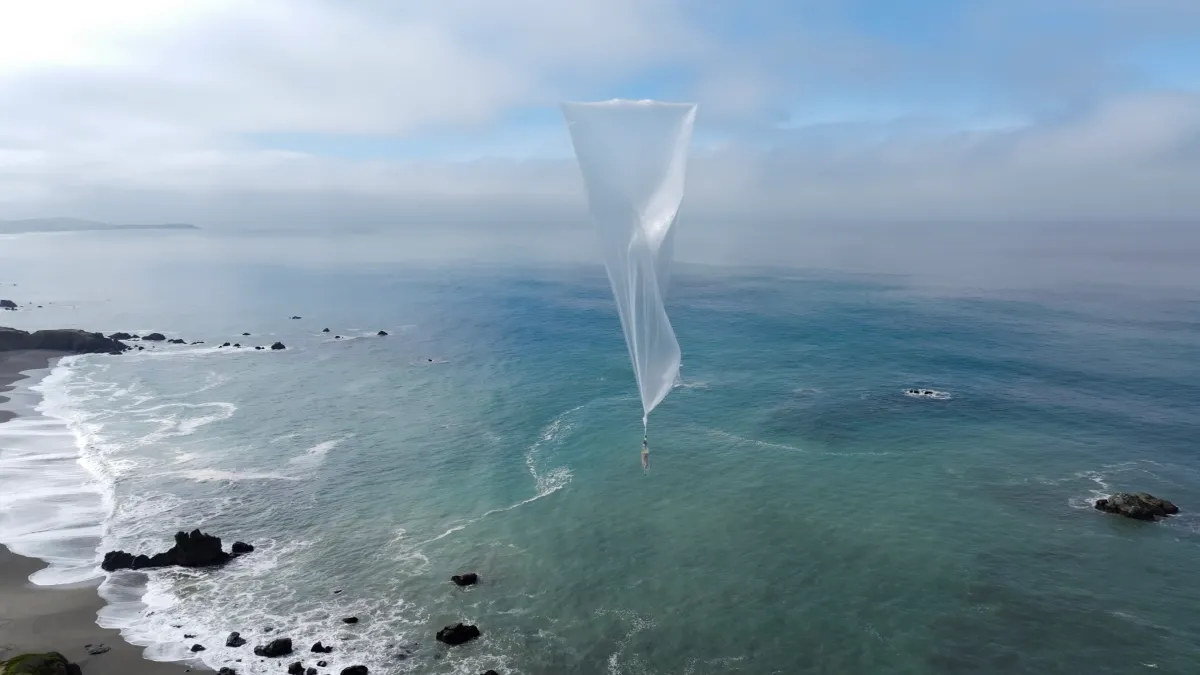
The U.S. Air Force has finalized a sole-source contract worth up to $49 million with WindBorne Systems to purchase atmospheric telemetry gathered by the company's autonomous balloon constellation. The transaction marks a definitive operational shift toward funding physical edge sensors to supply training pipelines for deep learning weather prediction models.
Rather than relying purely on orbital imagery or government supercomputer simulations, defense planners are purchasing commercial atmospheric soundings on demand. The Pentagon's commitment follows an initial purchase order of $1.7 million, formalizing a procurement mechanism designed to scale with operational deployments across disputed and data-sparse airspaces.
The Defense Procurement Vehicle: Deconstructing the $49 Million Air Force Commitment
Under the terms of the indefinite-delivery contract, the U.S. Air Force does not transfer a lump-sum award upfront. Instead, the military branch issues targeted task orders for specific geographic coordinates and collection intervals, paying solely for sensor data delivered to defense meteorologists. While initial obligations stand at $1.7 million, leaving $47.3 million in uncommitted ceiling, company leadership confirmed to TechCrunch that follow-on orders are expected as military operations expand.
The procurement process bypassed competitive bidding under a statutory sole-source determination. Federal procurement officers established that WindBorne's balloon architecture represented the only operational commercial system capable of delivering continuous, multi-altitude atmospheric soundings at global scale. “This is largely a vehicle through which continued growth of the constellation can be supported, as well as some work on research and development to continue to improve the hardware and performance of the balloons,” WindBorne co-founder and Chief Technology Officer Andrey Sushko told TechCrunch. He added that the contract reflects “a determination by the government that for this capability of collecting global data, we were the only company able to provide it in the way that met their needs for these operations.”
Physical Edge Sensing: How 700 Unpowered Balloons Navigate the Atmosphere
WindBorne maintains an active constellation of approximately 700 miniature balloons floating through the troposphere and stratosphere. Unlike conventional weather sounding balloons, which rise vertically for two hours before bursting and falling to earth, WindBorne's vehicles are engineered for multi-week endurance. They execute autonomous horizontal navigation without propulsion motors, relying on targeted altitude shifts to catch directional wind strata by bleeding lift gas or dropping granular sand ballast.
This variable-buoyancy control architecture underwent field validation in August 2026, when WindBorne navigated an unpowered balloon directly into the eye of an active typhoon. Penetrating a tropical cyclone without mechanical propulsion requires real-time integration of micro-meteorological forecasts into flight steering algorithms. As Sushko noted regarding the milestone: “That’s a pretty novel step, and the two ingredients for that are one, having good wind and weather models, and knowing how to navigate them; and two, having a large enough constellation that you have balloons in the right places. It’s one of the first times that a deep-learning model was used for actual operational decisions.”
Neural Inference vs. Classical Physics: The Economic Shift from Supercomputers to WeatherMesh
The operational telemetry gathered by the balloon constellation feeds directly into WindBorne's proprietary foundation model, WeatherMesh 6. Historically, global numerical weather prediction (NWP) has required high-performance computing centers operated by organizations like the European Centre for Medium-Range Weather Forecasts (ECMWF). These state installations deploy thousands of CPU cores for hours at a time, calculating discrete numerical approximations of fluid dynamics and thermodynamic differential equations.
WeatherMesh 6 diverges from this legacy computational paradigm by deploying end-to-end deep learning architectures. By training neural representations on decades of historical reanalysis datasets alongside fresh empirical observations, deep learning models generate ten-day global forecasts in seconds on modern GPU accelerators. WindBorne claims that WeatherMesh 6 now delivers superior predictive accuracy over the ECMWF Integrated Forecasting System across key atmospheric metrics, drastically reducing the electrical and compute expenditures associated with petascale physics simulations.
The Empirical Data Ceiling: Why Atmospheric Models Stalled Without In-Situ Telemetry
Despite the algorithmic breakthroughs demonstrated by neural architectures like Google DeepMind's GraphCast, deep learning weather models face a severe data bottleneck. Satellite radiometers provide broad horizontal coverage, but their sensors struggle to resolve fine-grained vertical temperature, moisture, and pressure gradients near the planetary boundary layer. Furthermore, over 80 percent of the Earth's surface—encompassing vast oceanic tracts and polar expanses—lacks terrestrial weather radar and routine radiosonde launches.
Training neural forecasting networks on synthetic reanalyses without in-situ observations causes compounding error drift over multi-day inference horizons. By deploying continuous in-situ soundings from 700 mobile platforms, WindBorne injects ground-truth vertical columns into its training sets. This physical data advantage explains the defense sector‗s interest: precise micro-weather intelligence directly influences high-altitude drone routing, aerial refueling windows, and carrier strike group positioning.
Operational Constraints: Validated Flight Hours and Outstanding Procurement Milestones
The $49 million ceiling establishes an authorized framework rather than a guaranteed revenue stream for WindBorne. With $1.7 million ordered to date, the realization of the remaining $47.3 million depends on the Air Force executing task orders during major theater training cycles and contingency operations. The startup's recent $37 million Series B funding round, secured in August under chief executive John Dean, provides runway to expand manufacturing while military integration proceeds.
On the technical front, independent meteorological bodies have yet to publish formal peer-reviewed verifications comparing WeatherMesh 6 against the ECMWF operational suite in parallel civilian deployments. Civilian weather services and defense commands continue to operate neural systems alongside traditional dynamical ensembles rather than decommissioning legacy supercomputers. Long-term commercial viability will depend on whether WindBorne's proprietary empirical stream can consistently prevent model divergence under extreme, unmodeled climate anomalies.
Was this article helpful?
Your feedback helps our editorial team refine reporting depth and accuracy.
Related Articles
Oct 27, 2026
DHS Issues FASCSA Order Banning DeepSeek and Derivative AI Models Across Federal Systems
A federal directive banning software built on DeepSeek implementations exposes the technical impossibility of auditing open-weight distillation in enterprise software.
Oct 27, 2026
Anthropic Files S-1 for Nasdaq Debut: $16.3B Revenue Surge Confronts $80.7B Accounting Loss and Hyperscaler Compute Commitments
Behind the sensationalized $80.7 billion paper loss sits an operational engine posting $16.3 billion in annualized revenue, overshadowed by $548 billion in compute commitments.

Oct 27, 2026
Moonshot AI Unveils Kimi K3.1 Pro: 2.8T MoE Architecture Cuts Inference Costs 55% Ahead of Open Weights Drop
Moonshot AI claims a 55% inference cost cut with its 2.8-trillion parameter Kimi K3.1 Pro, but deploying open-weight reasoning at this scale trades cloud margins for enterprise memory bandwidth bottlenecks.