NVIDIA Solves Spatial Forgetting to Build Explorable 3D World Models
NVIDIA Lyra 2.0 generates explorable 3D environments from a single photo, combining spatial memory with self-correcting drift training.
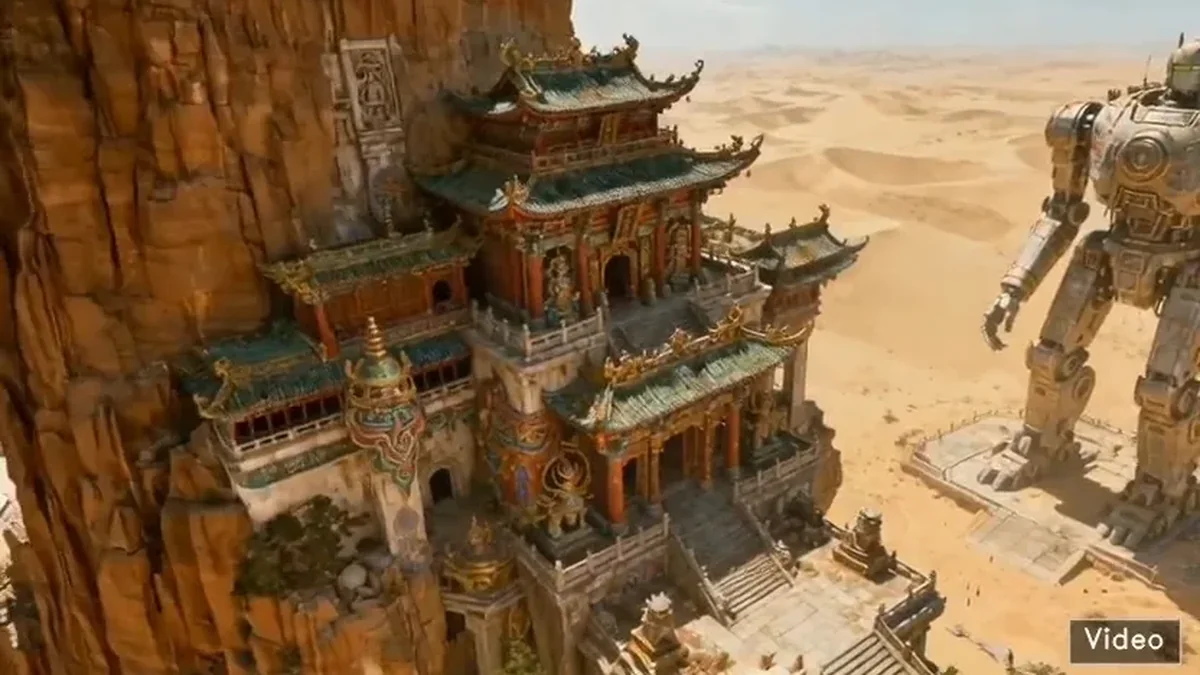
NVIDIA showcased research demonstrations for its Lyra 2.0 framework on November 6, 2026, outlining technical presentations scheduled for NVIDIA at SIGGRAPH Asia 2026 in Kuala Lumpur. The system generates explorable, spatially coherent three-dimensional environments from a single static photograph coupled with a user-defined camera trajectory, building upon foundational architectures first released by the NVIDIA Spatial Intelligence Lab in April 2026.
In practical operation, a user provides an input photo and a planned navigation path, prompting the diffusion model to synthesize a continuous exploration video that a feed-forward reconstruction pipeline converts into explicit three-dimensional assets. Traditional generative models excel at producing isolated perspective views, yet they degrade rapidly when tasked with maintaining geometric consistency across extended camera navigations. The architecture of Lyra 2.0 addresses this gap by converting synthesized visual sequences into persistent volumetric representations that users can inspect and simulate from unconstrained viewpoints.
The primary engineering contribution centers on decoupling visual appearance synthesis from spatial geometry routing across long camera paths.
Spatial Memory and Self-Augmented Drift Mitigation
Standard autoregressive video models encounter two severe failure modes when synthesizing extended camera movements through physical spaces. Spatial forgetting occurs when a virtual camera navigates away from an environment feature and returns, causing unconstrained models to hallucinate entirely new structural layouts. Temporal drifting compounding errors across consecutive frame iterations gradually degrade geometric proportions and surface textures over time. These combined degradations traditionally prevented generative models from producing reliable assets for downstream spatial computing workflows.
According to the official NVIDIA Project Lyra 2.0 research documentation, the system counters spatial forgetting by maintaining a per-frame three-dimensional geometry cache utilized strictly for spatial routing rather than direct rendering. This topological memory identifies dense correspondences between target camera positions and previously visited coordinates, allowing the model to retrieve past visual references accurately.
To mitigate temporal drifting, the architecture trains against self-augmented historical outputs containing synthetic imperfections. Exposing the diffusion pipeline to its own degraded generations teaches the underlying network drift correction rather than compounding structural errors over extended paths. This dual-mechanism design enables long-horizon navigation sequences that remain geometrically anchored across complex camera paths.
Accelerated Diffusion Distillation and Volumetric Reconstruction
Synthesizing continuous camera trajectories serves as an upstream data generator for feed-forward three-dimensional reconstruction models.
Computational efficiency serves as a primary engineering priority within the underlying generation architecture alongside geometric consistency. The baseline diffusion framework requires 35 denoising steps to synthesize each sequence of novel viewpoints. To accelerate generation, researchers trained a distilled variant that executes across four denoising steps, achieving an approximate 13-fold speedup per step while preserving comparable visual fidelity. This distillation reduces inferencing bottlenecks when generating extended camera trajectories for downstream asset creation.
The generated video stream transfers into explicit geometric representations using 3D Gaussian Splatting and reconstructed polygonal surface meshes. Gaussian primitives capture complex radiance fields and lighting interactions, providing real-time rendering performance across interactive navigation interfaces while surface meshes supply exportable geometry for external simulation engines.
Unlike conventional monocular depth estimation methods that warp single viewpoints, multi-frame trajectory synthesis reconstructs occluded areas located entirely behind initial camera sightlines.
Robotics Simulation and Embodied AI Integration
The engineering utility of persistent world generation extends directly into robotics navigation and synthetic environment generation. Within the official demonstrations, NVIDIA researchers exported reconstructed Lyra 2.0 scenes directly into the NVIDIA Isaac Sim platform. Simulated mobile robots navigated these generated environments using synthetic sensor arrays, demonstrating that image-derived volumetric assets support physical motion planning workflows.
Exporting generative environments into physics-based engines reflects a broader effort across spatial computing to close the training data scarcity gap in embodied AI.
Evaluating how autonomous policies navigate physical constraints remains a critical bottleneck, as documented in the RoboColosseum benchmark analysis of humanoid AI evaluation, where physical reasoning failures frequently outpace visual perception capabilities. Synthetic scenes generated from photographs provide an automated mechanism for expanding training scenarios without costly physical photogrammetry capture. Independent research presented at SIGGRAPH Asia 2026, including the GLOSS framework for geometric material transfer, illustrates complementary progress in texturing physical assets. Both developments indicate that spatial AI and computer graphics research has progressed from generating disconnected pixels toward engineering functional physical representations.
Architectural Frontiers and Simulation Adoption Limits
Engineering teams evaluating Lyra 2.0 must balance its architectural capabilities against documented technical boundaries. Detailed technical analysis published by Mogura VR News confirms that the current framework operates strictly on static scenes, lacking native capabilities to model dynamic actors, moving foliage, or shifting lighting conditions.
Reconstruction pipelines also exhibit sensitivity to exposure discrepancies across synthesized perspectives, occasionally producing clouding artifacts within Gaussian radiance fields. Training data biases constrain the system when synthesizing structural layouts that diverge sharply from its architectural training distribution. Engineers seeking deterministic architectural measurements cannot treat these generated meshes as certified engineering scans.
Commercial software deployments encounter additional operational boundaries related to licensing frameworks.
NVIDIA published the inference and GUI codebase under the Apache 2.0 license on GitHub, enabling broad academic inspection. However, the underlying trained model weights remain restricted under an Internal Scientific Research and Development License. Commercial developers cannot embed these model weights into commercial production systems without separate proprietary licensing agreements. This dual-licensing posture preserves open research collaboration while protecting proprietary enterprise assets.
Technical evaluation of Lyra 2.0 establishes that generative world modeling has progressed from producing ephemeral videos toward synthesizing actionable spatial geometry. Enterprise simulation pipelines will increasingly incorporate feed-forward spatial models as downstream physical engines standardize automatic radiance field ingest.

Written by Adriano Nascentes
Founder & Lead AI Systems Analyst · Verified Staff
Founder and editor-in-chief of Unknown Observer. Technology researcher and software engineer investigating foundation models, autonomous agent runtimes, cognitive architectures, and frontier AI safety.
Was this article helpful?
Your feedback helps our editorial team refine reporting depth and accuracy.