How NVIDIA Is Turning AI Agents Into Specialized Industrial Workers
NVIDIA expanded its Agent Toolkit to bring autonomous AI into factories, drug discovery, and automotive CAD while deploying OpenShell to sandbox execution.
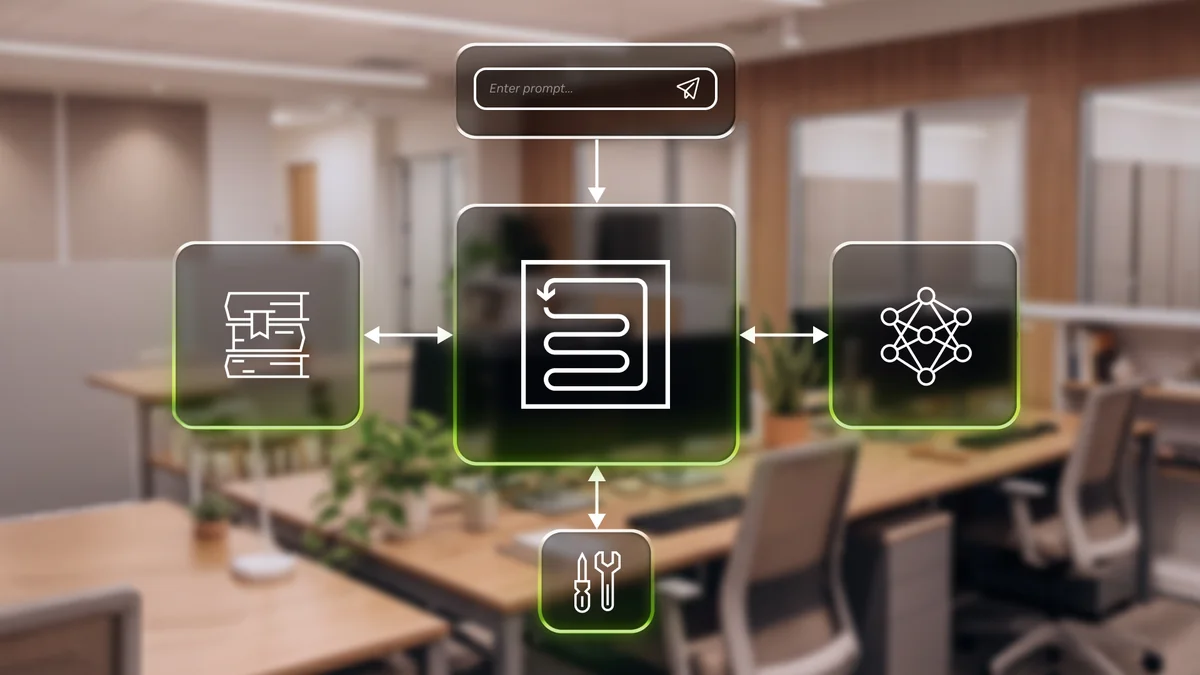
A major inflection point is emerging across enterprise computing as autonomous AI agents move past simple conversational retrieval toward direct execution in operational environments. On November 4, 2026, NVIDIA expanded its open source Agent Toolkit, formalizing an open stack detailed in its official announcement to ground models in proprietary enterprise data and establish execution boundaries across specialized industrial tasks.
The initiative builds directly upon the groundwork presented during GTC Berlin on October 21, 2026, where chief executive Jensen Huang positioned domain-specific agents as operational workers rather than generalist digital assistants. Unlike consumer-facing chat interfaces that generate unstructured prose from text prompts, these systems connect directly to structured enterprise databases, physical simulators, and engineering workflows. Three flagship deployments—spanning oncology discovery at Lila Sciences, manufacturing optimization at Siemens, and mechanical design at Dassault Systèmes—illustrate how autonomous agents are deployed to execute domain tasks. This operational integration exposes a fundamental tension between programmatic autonomy and corporate risk management.
Giving an AI agent access to production databases and execution tools fundamentally alters enterprise security posture.
When a model interprets instructions incorrectly or issues unverified tool calls, the failure mode shifts from an inaccurate chatbot answer to an unauthorized modification of enterprise infrastructure. The architecture introduces OpenShell, an execution sandbox that enforces deterministic access policies and isolates credentials outside the model's control plane. This framework marks a deliberate transition from prompt-based safeguards toward operating system-level execution control.
From Text Generation to Enterprise Knowledge Graphs
Modern enterprise systems generate massive volumes of structured tables, telemetry logs, and relational databases that traditional retrieval-augmented generation pipelines struggle to navigate. NVIDIA addresses this structural limitation through its Agent Knowledge Foundation, which combines accelerated CUDA-X computing libraries with the newly introduced Auto-Ontology framework.
Rather than treating company documents as disconnected vector embeddings, Auto-Ontology constructs conceptual knowledge graphs that map operational relationships between customers, physical inventory, and transactional orders. The framework couples these semantic mappings with specialized open models from the Kumo family, including Kumo Relational, Kumo Tabular, and Kumo Time Series, to generate predictive forecasts directly from structured data. Retrieval latency is managed through the Nemotron Retriever family, where specialized embedding and reranking models accelerate query routing across distributed document repositories. Early corporate deployments highlight how this infrastructure enables agents to analyze complex supply chains without requiring manual data migration or workflow reconstruction.
The architecture operates on the principle that specialized tools determine whether an agent can perform meaningful computational work.
During the GTC Berlin presentation, Jensen Huang emphasized this operational requirement, noting that "CUDA-X tools are what gives agents the tools of the trade" when accelerating solvers and data-processing engines. Accelerating libraries such as cuDF, cuGraph, and cuOpt enables agents to execute combinatorial optimization problems in seconds rather than hours. This capability allows autonomous systems to function as active computational nodes rather than passive query responders.
Three Production Deployments Across Science and Industry
Concrete deployments across biopharma, electronics manufacturing, and automotive engineering demonstrate how domain-specific toolkits diverge from conversational assistants. Each implementation embeds agents inside specialized software environments where mistakes carry tangible financial and physical consequences.
At biotechnology company Lila Sciences, autonomous agents utilize the BioNeMo Agent Toolkit to analyze molecular docking and assist in developing candidate therapies against B-cell lymphoma. These agents coordinate computational biology models with automated laboratory hardware, running iterative virtual experiments to propose validated compound designs. In automotive engineering, Dassault Systèmes demonstrated agents operating within product lifecycle management software to adapt a Volkswagen Golf door assembly to fit the Volkswagen Tiguan. The agent evaluated mechanical constraints, modified geometric CAD parameters, and executed vibration simulations before presenting the final engineering candidate to a human engineer for formal sign-off.
The most revealing operational baseline originates from high-volume electronics manufacturing at Siemens.
At the Siemens Electronics Factory in Erlangen, Germany, an AI agent coordinates production planning by evaluating incoming orders, component inventories, and factory floor constraints against a digital twin of the entire facility. According to Siemens partnership details published on October 19, 2026, this agent-based planning workflow enables operational cost reductions of up to 20% while virtual production preparation cuts engineering effort by up to 85% for printed circuit board assemblies. The factory, which manufactures power electronics with approximately 1,000 employees, validates every machine reconfiguration in a virtual simulation before physical production lines are altered.
Enforcing Execution Sandboxes Beyond Prompt Filters
Granting software agents the authority to execute code, invoke APIs, and modify database records introduces severe operational hazards that conversational guardrails cannot mitigate. When autonomy expands into enterprise execution environments, permission boundaries become the primary determinant of system stability, as demonstrated by incidents involving internal tooling vulnerabilities in automated architectures.
This operational danger was detailed by offensive security researchers Rich Harang and Becca Lynch of the NVIDIA AI Red Team on July 30, 2026, in a technical assessment examining enterprise agent deployments. Their investigation identified four systemic failure modes: absent agent access controls, unrestricted command-line tool execution, lack of network egress restrictions, and plaintext secret exposure within agent context windows. Attackers can exploit these flaws through indirect prompt injection to trigger arbitrary code execution, exfiltrate sensitive files, or spawn reverse shells on host systems. As Harang and Lynch documented, "Prompt-based guardrails, including the LLM-as-a-judge pattern, do not close any of these gaps" because adversarial input can readily manipulate model reasoning.
Architectural defenses require moving security enforcement completely outside the model process.
NVIDIA implements this separation through OpenShell, an open-source runtime that isolates agent execution within a hardened sandbox. The runtime intercepts every outbound tool call, enforces strict default-deny network egress rules, and retrieves credentials on demand via dedicated secrets managers without exposing tokens to the agent context. This mechanism ensures that even if an underlying foundation model is hijacked by adversarial input, external policy enforcement prevents unauthorized network connections or file system modifications.
Structural Shifts in Enterprise Infrastructure Competition
The expansion of the Agent Toolkit illustrates how the competitive moat in enterprise artificial intelligence is shifting away from frontier model parameter counts toward domain software integration. While frontier models serve as reasoning engines, enterprise utility depends on whether those models can safely interact with proprietary data stores and established operational tools.
By partnering directly with enterprise stalwarts such as Siemens, Dassault Systèmes, Palantir, and Snowflake, NVIDIA embeds its compute ecosystem inside established industrial workflows. This strategy diversifies the company's revenue model beyond selling graphics processing units, establishing a software control plane that governs enterprise agent deployments. Organizations deploying these systems must balance the productivity gains of autonomous execution against the engineering discipline required to maintain deterministic security boundaries. Similar considerations already govern autonomous robotics, as documented in recent physical robotics evaluation benchmarks that highlight the divide between digital planning and physical execution.
Production reliability ultimately hinges on verifiable isolation rather than model optimism.
Enterprises adopting autonomous agents must treat model actions as untrusted system inputs that require continuous telemetry auditing and runtime sandboxing. As industrial deployments scale through 2027, the standard for enterprise adoption will be measured by deterministic permission enforcement rather than conversational fluency. Operational teams that establish strict runtime boundaries will capture automated efficiency without exposing their core infrastructure to unconstrained agent execution.
Was this article helpful?
Your feedback helps our editorial team refine reporting depth and accuracy.
Related Articles
Why Every Frontier AI Failed Humanoid Tasks in 5,699 Trials
RoboColosseum evaluated 8 AI models across 5,699 real-world robot trials. Every model failed humanoid manipulation tasks, revealing key physical AI limits.
How Internal AI Tooling Enabled Lateral Movement in Binance's $6.34 Billion Breach
Binance revealed how an internal AI tool enabled lateral movement in the $6.34B crypto breach, facilitating EIP-7702 smart contract execution delegation.

Google Antigravity Migrates 40-Year-Old Scientific Fortran to Rust in 59 Minutes
Google Antigravity migrated a 174K-line Fortran ocean model to safe Rust in 59 minutes, uncovering six legacy bugs and achieving 1.88x faster simulations.