Grok Integrates Image and Video Generation Directly Into Chat, Splitting Creator Sentiment
xAI folds Grok Imagine into its main chatbot, sparking tension between conversational simplicity and advanced creative control.
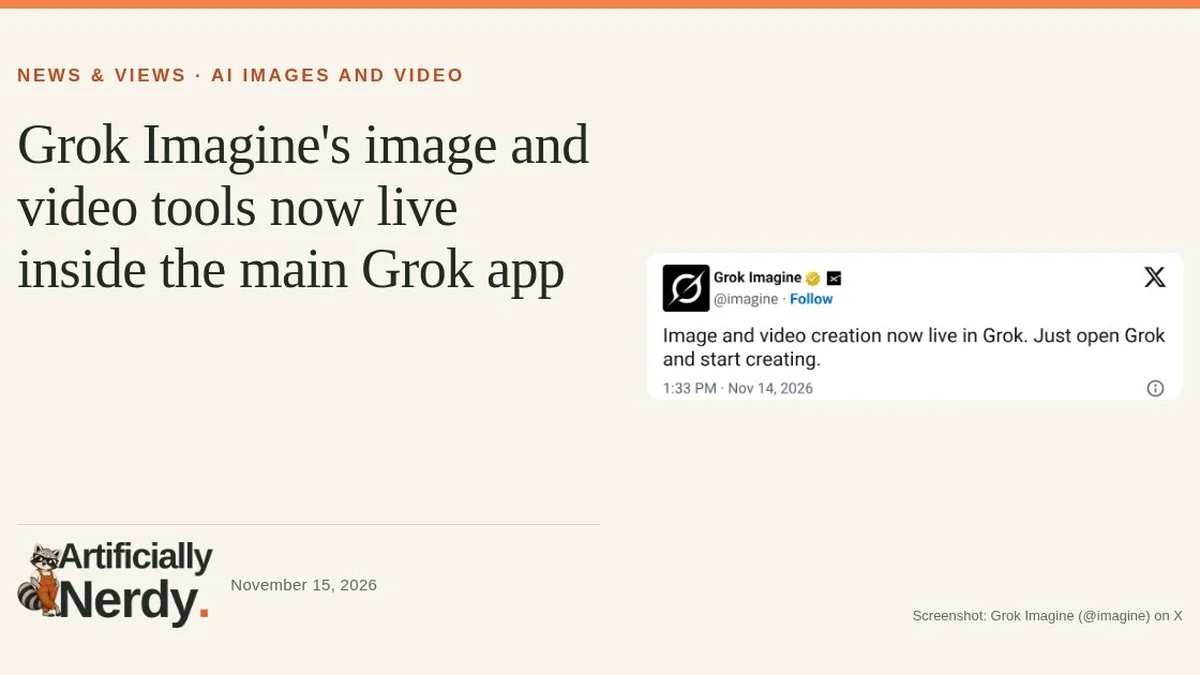
On 14 November 2026, xAI announced that image and video generation tools from Grok Imagine are now accessible directly within the main Grok conversational interface. The update marks a structural consolidation in xAI's product strategy, folding standalone creative generation into a unified text environment.
By moving multimodal generation into standard chat streams, xAI is aligning its consumer footprint with competitors like OpenAI and Google. This migration has quickly exposed an enduring friction in generative software design. The shift highlights the operational gap between conversational access and the granular control required by professional creators.
Consolidating Multimodal Creation Into Conversational Streams
The transition was announced in coordinated posts on X from the official Grok Imagine and Grok accounts on 14 November 2026. The Grok Imagine team stated that multimodal generation was "now live in Grok," centralizing creative tasks and routine queries in a single workflow.
A minute later, the parent Grok account described the consolidation as bringing company products "into one Grok experience" across creation and daily productivity. This design mirrors the architectural choices of ChatGPT and Gemini, where visual generation operates alongside code generation, drafting, and analytical queries. For casual users, the friction of switching between browser tabs or operating a separate prompt terminal disappears. Routine requests and visual deliverables now occupy the same conversational context.
Writing a marketing prompt and generating its accompanying visual asset can now occur in a continuous conversational session without external orchestration. However, consolidating a specialized creative suite into a general-purpose chat interface alters how users interact with the underlying models.
Technical Divergence Between Developer APIs and Consumer Chat
Behind the streamlined consumer interface lies a noticeably more capable technical infrastructure documented for enterprise access.
According to official xAI developer documentation, the proprietary video model architecture is anchored by grok-imagine-video-1.5 and its companion variant grok-imagine-video-1.5-lite. The documented API capabilities extend well beyond basic text-to-video conversions. The architecture supports durations from 1 to 15 seconds, output resolutions reaching up to 1080p, image-to-video animation, and directional keyframing along a third-of-a-second temporal grid.
Furthermore, generated clips produced via the 1.5 pipeline incorporate an audio track by default with lip-synced speech. Within the consumer chat interface, operational parameters face stricter constraints.
Creator Sentiment and the Boundaries of Simplified Interfaces
Publicly accessible text-to-video generation through the chat interface is capped at 15 seconds at 720p resolution. This split illustrates a deliberate operational divide: while the underlying weights support broadcast-grade outputs, web inference for everyday users is bounded to preserve compute efficiency and lower serving latency. The consolidation has generated debate across creator communities as users observe the gradual migration of the standalone Imagine tab. Several users reported that dedicated workspace menus have disappeared from their accounts, redirecting generation workflows into conversational threads.
Early community feedback published by Artificially Nerdy reporting noted that creators who valued dedicated tools now face a more crowded workspace. Creator concerns center primarily on the perceived compression of fine-grained creative parameters.
In specialized image and video generation portals, creators rely on explicit aspect ratio selectors, negative prompt fields, and persistent asset libraries. Within the chat stream, these parameters must either be inferred through descriptive natural language or managed through sequential conversational adjustments. While online discussions have circulated unverified claims regarding internal team restructuring and staff reassignments, verified reporting confirms only the functional migration of the product interface.
Regulatory Scrutiny and the Operational Demands of Deepfake Governance
The company has not issued a formal notice establishing a permanent global shutdown of the standalone dashboard for enterprise accounts, leaving user access varying by profile status and subscription tier.
The expansion of frictionless video generation arrives against a backdrop of heightened regulatory scrutiny over safety boundaries and synthetic media. In June 2026, the Office of the Privacy Commissioner of Canada published its formal investigation under PIPEDA Findings #2026-004, concluding that X Corp. and X.AI LLC violated federal privacy provisions through the generation of non-consensual sexualized deepfakes. The Canadian watchdog determined that the companies failed to obtain valid consent from identifiable individuals whose likenesses were exploited. The report established that technical safeguards were insufficient to prevent widespread misuse, noting that "adversarial users" repeatedly bypassed automated keyword filters by deploying seemingly innocuous prompting terms.
Consequently, the Commissioner recommended suspending Grok Imagine operations until demonstrable safeguards could be verified through independent technical audits. In their formal response to Canadian regulators on June 11, 2026, the companies maintained that suspending Grok Imagine "is not warranted" given their deployment of layered moderation systems and proactive social media monitoring.
Structural Tension in Unified AI Product Strategy
The companies subsequently committed to delivering quarterly efficacy reports and submitting to annual third-party audits. As multimodal creation enters an accessible chat interface, the operational challenge of enforcing these safeguards expands substantially across a larger user base. The integration of Grok Imagine into conversational chat demonstrates the ongoing pressure on frontier labs to package fragmented capabilities into cohesive consumer ecosystems.
Consolidating disparate creative models into a single input stream drives top-of-funnel engagement and reduces product sprawl across multiple domains. Enterprise builders balancing computational commitments, such as infrastructure investments detailed in recent coverage of semiconductor partnerships, frequently prioritize platform consolidation to maximize subscriber retention. Yet this convenience carries clear consequences for technical workflows. When specialized creative tools are subordinated to general-purpose chatbots, granular precision inevitably yields to conversational simplicity. As safety mechanisms confront threats from synthetic identity manipulation documented in reports on deepfake video vulnerabilities, the trajectory of xAI's creative suite will depend on whether developer APIs and consumer chat can coexist without alienating technical creators who require deterministic parameter control.

Written by Adriano Nascentes
Founder & Lead AI Systems Analyst · Verified Staff
Founder and editor-in-chief of Unknown Observer. Technology researcher and software engineer investigating foundation models, autonomous agent runtimes, cognitive architectures, and frontier AI safety.
Was this article helpful?
Your feedback helps our editorial team refine reporting depth and accuracy.