Gemini to Google Sites: The Engineering Architecture Behind One-Click App Publishing
Google officially connects Gemini interactive applications directly to Google Sites drafts in a single click, shifting generative UI from isolated chat sandboxes to enterprise intranets governed by Google Drive ACLs.
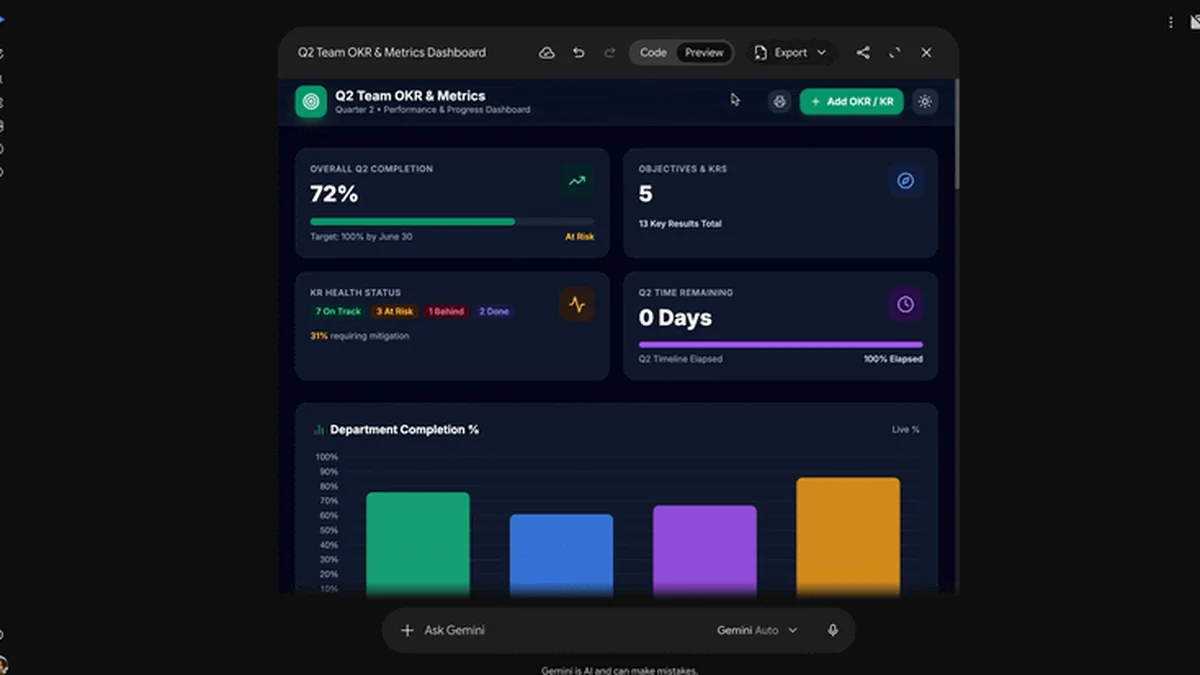
Google officially rolled out a native export integration on October 19, 2026, allowing users to transfer interactive applications built inside the Gemini web and mobile apps directly into Google Sites drafts. The update establishes a direct publishing pipeline between conversational generative models and the company's enterprise intranet platform.

Reported by [Chrome Unboxed](https://chromeunboxed.com/google-sites-now-turns-your-gemini-apps-into-live-web-tools-in-one-click/) on October 20, 2026, the feature addresses the persistent deployment barrier separating conversational AI prototypes from shared internal tooling. By converting ephemeral chat outputs into persistent workspace components, Google bypasses traditional frontend build pipelines while anchoring application governance directly to Google Drive access controls.

## Beyond the Chatbox: Bridging Generative UI with Enterprise Intranets

Generating functional UI components inside chat interfaces has evolved rapidly across frontier LLM platforms, but moving prototypes into production environments traditionally encountered significant operational friction. Developers and business users routinely relied on manual copy-pasting, custom iframe wrappers, or third-party web hosting services simply to share a working calculator, questionnaire, or departmental dashboard. These fragmented workarounds severed the tool from corporate authentication layers, creating maintenance overhead and security vulnerabilities across organizations.

The new workflow automates this extraction through an integrated UI action across supported clients. When a user generates an interactive web application inside Gemini, selecting Export > Google Sites triggers an automated deployment sequence. The engine compiles the generated markup, styling, and JavaScript logic, instantiating a private site draft in Google Sites where the tool renders in a fully interactive state immediately upon creation without requiring manual code refactoring.

Furthermore, this bridge transforms conversational prototyping from an isolated personal session into an asynchronous collaborative workspace. Coworkers can annotate the host Google Site, embed companion documentation directly from Google Drive, and adjust adjacent layout blocks alongside the live AI widget before publishing.

## The Sandbox Runtime: Client-Side Execution Under Google Drive ACLs

The underlying runtime architecture functions without provisioning dedicated server instances or cloud containers. Instead, the exported Gemini application executes entirely as client-side code within sandboxed iframe containers embedded directly in the Google Sites canvas. This design isolates DOM execution from the host page, restricting script execution to local browser memory and standard browser Web APIs.

From an administrative perspective, Google introduced zero configuration switches to manage the capability. The Google Workspace Team confirmed that no new administrative controls were deployed to the Google Admin Console for this integration. Access is determined strictly by whether users already hold permissions to create and edit Google Sites within their organizational unit.

This governance choice delegates application security directly to the Google Drive storage layer. Because every Google Site is managed as a Drive file object, the embedded application inherits the domain's existing Access Control Lists (ACLs). An exported financial estimator or customer intake form remains bound to corporate identity providers, preventing external execution unless the site owner explicitly alters Drive sharing settings to allow public web access.

Consequently, security parameters rely on familiar storage boundaries rather than novel cloud permission policies. Enterprise data protection rules configured at the root Drive level automatically govern who can inspect, duplicate, or view the interactive deployment.

## Workspace Integration vs. Walled Gardens: How Gemini Compares to Artifacts and Canvas

The architectural strategy behind Google Sites integration contrasts sharply with competing generative UI ecosystems. In June 2024, Anthropic established the split-screen execution paradigm with Claude Artifacts, followed in October 2024 by OpenAI's release of ChatGPT Canvas. Both systems focused primarily on personal authoring workspaces, isolating the created artifacts within proprietary chat threads or vendor-hosted shareable links that lack native ties to corporate identity providers.

Google’s approach prioritizes corporate distribution over isolated sandboxes. Rather than treating micro-applications as temporary conversational artifacts, the system routes generated interfaces directly into enterprise content management workflows already populated by corporate intranets, team documentation, and shared Drives.

| Architectural Dimension | Google Gemini + Google Sites | Anthropic Claude Artifacts | OpenAI ChatGPT Canvas |
| :--- | :--- | :--- | :--- |
| **Hosting Target** | Native Enterprise CMS (Google Sites) | Proprietary Web Client / CDN Link | ChatGPT Thread / Shared Link |
| **Access Control Model** | Google Drive Enterprise ACLs & SSO | Public URL or Authenticated Chat | Workspace Team or Public Link |
| **Backend Integration** | Client-Side Sandbox (DOM/Drive) | Client-Side React/HTML Sandbox | Client-Side JS/Python Interpreter |
| **Publishing Mechanism** | 1-Click Export to Collaborative Draft | Code Export or Static View Link | Code Copy or Canvas Fork |
| **Admin Controls** | Inherited Domain Sites Policy | Workspace Organization Gating | Workspace Administrative Toggles |

By leveraging Google Sites as the deployment surface, Google eliminates the secondary step of hosting negotiation. Teams do not need to register subdomains, provision serverless endpoints, or configure third-party hosting credentials to deliver a functioning internal widget.

## Architectural Bottlenecks: State Persistence and Shadow IT Exposure

Despite workflow conveniences, the technical implementation enforces distinct structural trade-offs. The runtime lacks native serverless compute or managed relational database backends, meaning exported applications remain fundamentally stateless. Session variables, form inputs, and computation states terminate when the browser tab closes unless developers manually wire the components to external APIs or Google Sheets via Google Apps Script.

Because execution is confined to client-side JavaScript, tools requiring persistent transactional storage cannot operate out of the box. Multi-user state synchronization, row-level database locking, and private server-side secrets remain outside the scope of the default export container.

Furthermore, bypassing administrative gating introduces operational friction for centralized IT departments. When non-technical employees deploy functional web tools without code review, organizations face localized shadow IT sprawl. While access remains constrained by Drive ACLs, auditing the underlying prompt logic, embedded external CDN dependencies, and algorithmic assumptions of hundreds of ad-hoc tools presents a significant administrative challenge.

## Operational Realities and Next Milestones for Enterprise AI Tooling

The immediate rollout reaches Rapid Release and Scheduled Release domains across web, Android, and iOS clients simultaneously. It serves Google Workspace enterprise tiers, Workspace Individual subscribers, and personal Google accounts with active Gemini privileges without requiring regional staged rollouts.

Enterprise systems architects must now evaluate operational boundaries. Google has not published documentation governing request rate limits, external API secret management, or automated version control for exported application code. Engineering teams overseeing Workspace environments must monitor permission audits on Google Drive objects to verify that client-side applications containing proprietary internal business logic remain restricted to authorized corporate domains.
Was this article helpful?
Your feedback helps our editorial team refine reporting depth and accuracy.
Related Articles
Oct 15, 2026
Anthropic: The $90 Billion Compute Gamble Behind the Nscale Expansion
Negotiations for a second $45 billion compute commitment at West Virginia's Monarch campus double Anthropic's exposure to independent cloud infrastructure as pre-IPO scrutiny mounts over multi-gigawatt capital expenditure.

Oct 13, 2026
OpenAI: Rushing $30 Billion Round at $1.4 Trillion Valuation to Preempt Anthropic IPO
OpenAI accelerates a $30 billion private funding round at a $1.4 trillion valuation, seeking sovereign capital to lock up balance sheets before Anthropic mid-November IPO.
Oct 11, 2026
The Telemetry Leak: Why AI Chatbots Expose Sensitive Session Data to Ad Trackers
An empirical network audit reveals nine major conversational AI tools routinely expose chat titles, session permalinks, and hardware identifiers to 44 adtech trackers.