Ambi: The $26M Ambient AI Bet to Eliminate Voice Hardware Latency
Mistlabs secures $26 million to bypass the upload bottlenecks of dedicated recording hardware, deploying background listening apps across Apple devices while offloading third-party consent risks to end users.
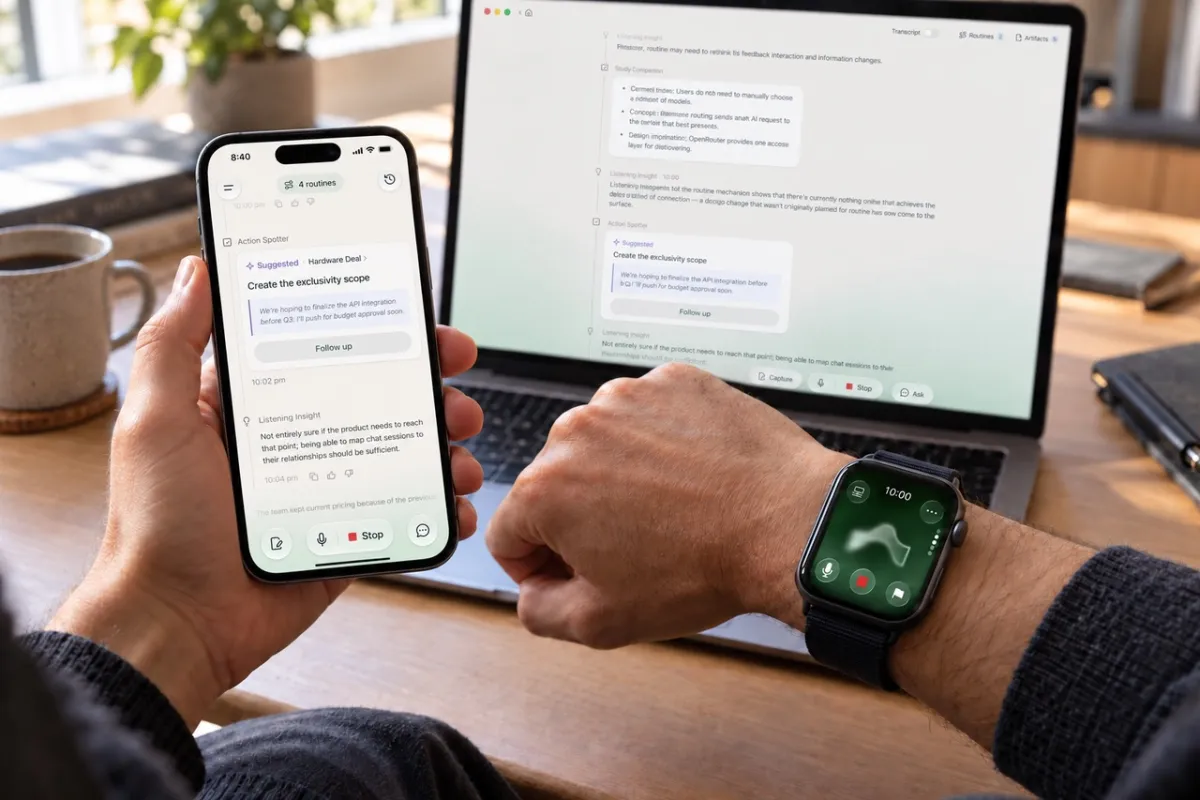
The commercial drive toward continuous ambient intelligence secured a major capital infusion this week as startups move away from offline recording cards toward background listening software. Mistlabs, the developer behind ambient productivity platform Ambi, raised $26 million across funding rounds co-led by venture capital firm Luminous Ventures and original design manufacturer Huaqin Technology, TechCrunch reported Monday. The venture was established by Peter Mo, a former executive at AI note-taking hardware maker Plaud, to build an audio intelligence engine designed to listen across devices throughout the day.
Ambi is deploying its client applications directly across Apple platforms, launching dedicated tools for iPhone, Mac, and Apple Watch. While the software operates conventionally as a meeting transcription utility, its core architectural premise relies on persistent background capture. Instead of requiring users to initiate recordings manually, the platform continuously processes auditory context across desktop and mobile workflows, signaling a deliberate move away from standalone recording cards toward unified software ecosystems.
Eliminating the Cascade Latency of Physical Recorders
The architectural rationale behind Ambi stems directly from the hardware friction that constrained first-generation voice recorders like the Plaud Note. Traditional voice hardware relies on local flash storage to buffer audio, requiring a sequential transfer cycle over Bluetooth Low Energy to a connected smartphone before files can reach cloud processing endpoints. This multi-hop pipeline creates latency bottlenecks of several minutes between the conclusion of a conversation and the generation of structured summaries.
Mo pointed to this procedural delay as the core justification for building an integrated ambient client. "The way we interact with intelligence is limited. Often the intelligence is trapped on the screen, and if you use hardware like Plaud, you need to wait for recording to transfer to the phone, upload to the cloud, and get intelligence after processing. That's why we are building Ambi to use AI anytime and anywhere," Mo told TechCrunch. By listening continuously from host devices, the platform seeks to bypass the physical handoff entirely.
Cross-Device Continuity and Active Meeting Execution
Unlike conventional meeting assistants that generate retrospective summaries once an audio stream terminates, Ambi aims to initiate computational tasks while conversations remain active. The agent cross-references incoming audio against external calendar data, historical meeting logs, local knowledge bases, and live web endpoints, attempting to surface reference materials or execute automated workflows in real time.
This real-time approach is paired with cross-device task continuity, enabling users to register an action item on an Apple Watch or iPhone and complete execution within a desktop Mac environment. Mistlabs is also developing a background desktop client that monitors active display surfaces to index on-screen documents into working memory, mirroring context-engine architectures seen in early experimental desktop software. Beyond its immediate Apple client footprint, the startup plans to manufacture a proprietary hardware terminal equipped with an integrated display, speaker, optical camera, and directional microphone array. Backing this hardware-software development pipeline is a workforce of over 50 employees operating across technical facilities in San Francisco, Beijing, Shanghai, and Shenzhen, with active recruitment targeting automatic speech recognition engineers.
The Compliance Dilemma and the Transfer of Disclosure Liability
The shift toward always-listening ambient capture introduces severe regulatory exposure regarding third-party consent. While cloud transcription platforms historically relied on visible bot participants joining conference calls, ambient mobile and desktop microphones record physical rooms without providing optical indicators to conversational partners. In corporate and cross-border enterprise environments, non-consensual voice capture collides directly with two-party consent wiretapping statutes and biometric privacy frameworks.
In the United States, class-action litigation filed under the Illinois Biometric Information Privacy Act has targeted meeting transcription vendors like Granola over the extraction of voiceprints and audio recordings without formal written consent, exposing platforms to statutory damages ranging from $1,000 for negligent infractions to $5,000 per willful violation. Ambi states that ambient audio capture is toggled off by default and can be suspended by the user at any point. The startup asserts that it does not retain permanent audio archives and encrypts operational data, though it has declined to disclose whether it utilizes end-to-end zero-knowledge protocols or holds server-side decryption keys.
The fundamental compliance burden, however, remains squarely placed on the end user rather than managed programmatically by the software. Mo conceded that technical mechanisms cannot compel operators to inform individuals in their vicinity that an ambient recording session is active. "We have to inform our users that they have to tell others about ambient capture. We, as an industry, haven't solved this problem [of disclosure]. We have tried to put the information about disclosure in every place possible, but if users try to hide the capture, we can't just solve the problem," Mo noted.
Confirmed Architectural Milestones and Unresolved Data Governance
What is confirmed is that Mistlabs has secured $26 million from institutional investors and manufacturing partner Huaqin Technology to deploy ambient capture software across iOS, macOS, and watchOS, alongside preliminary designs for a dedicated screen-and-camera terminal. What remains unresolved is the technical specification of its encryption layer, the precise latency cost of streaming uncompressed acoustic data to remote inference clusters, and whether background transcription can survive strict regulatory enforcement under biometric privacy statutes without hardware-enforced optical indicators.
Was this article helpful?
Your feedback helps our editorial team refine reporting depth and accuracy.
Related Articles
Aug 19, 2026
Amazon: Ending Data Center NDAs Exposes the Physical Limits of AI Scaling
Amazon Web Services joins Microsoft in terminating municipal nondisclosure agreements amid nationwide moratoriums, exposing the power grid bottlenecks capping AI data center expansion.

Aug 18, 2026
Apple: Reverse Acqui-Hire of Huxe AI Signals Push Into Interactive Audio Infrastructure
A regulatory filing under the European Digital Markets Act reveals Apple's deal to license Huxe AI tech and hire core engineers behind NotebookLM audio synthesis.

Aug 16, 2026
Microsoft: Satya Nadella Proposes AI Emergency Brake Architecture
Microsoft CEO Satya Nadella calls for treating AI models as insider risks, demanding deterministic external harnesses, tamper-proof logs, and emergency brakes.