Why Grok Bot Hit Weekly Limits and Strained Flat Subscription Economics
Elon Musk disclosed that Grok Bot's serving costs exceeded revenue, exposing the architectural clash between flat subscriptions and autonomous cloud agents.
On November 1, 2026, Elon Musk publicly disclosed that the cost of operating xAI's autonomous assistant had outpaced its incoming subscription revenue. The statement followed widespread subscriber reports of sudden weekly usage cap exhaustion across the platform.
Subscribers attempting to automate daily digital workflows found their accounts abruptly locked out with multiple days remaining until their scheduled pool reset. The friction highlights an escalating architectural tension between fixed-fee consumer subscriptions and the heavy infrastructure demands of autonomous artificial intelligence agents. As developer adoption expands, service providers face the economic challenge of funding unconstrained background compute through flat monthly billing models.
Elon Musk Confirms Serving Costs Exceeded Revenue on X
The public exchange began on November 1, 2026, when an X account operating under the handle @DogecoinNorway questioned Elon Musk regarding early quota exhaustion.
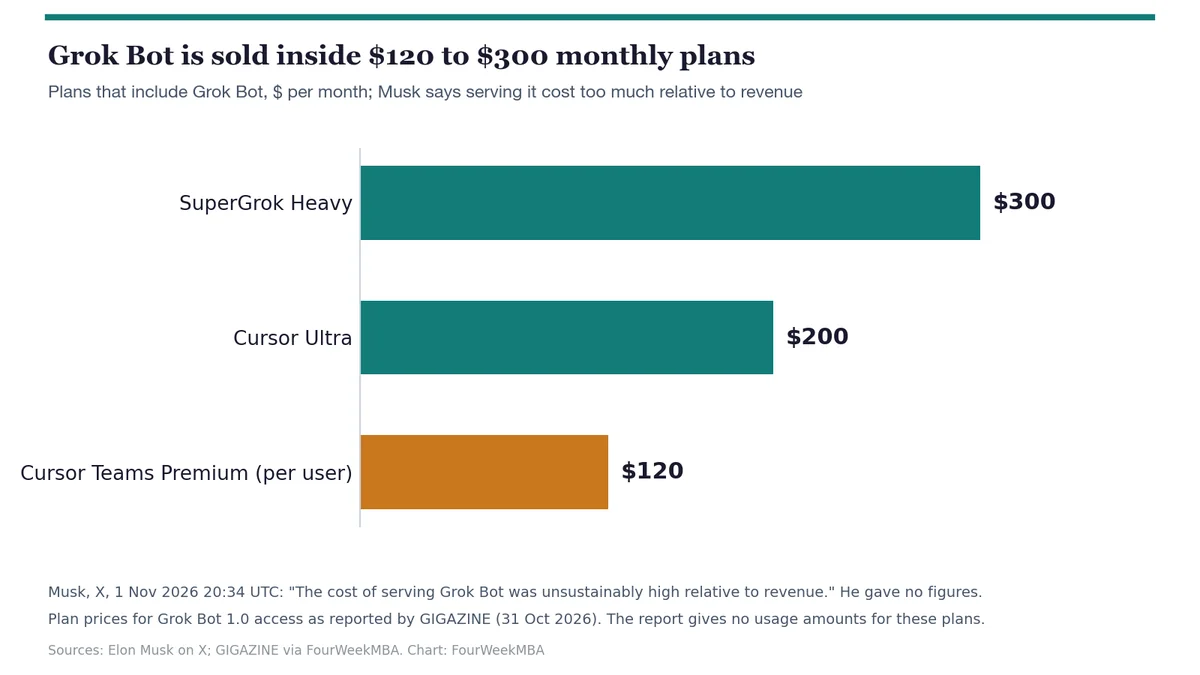
The user asked Musk whether xAI planned to issue a mid-cycle quota reset after multiple subscribers reported exhausting their allocations unusually early in the week. Musk answered directly from his personal profile at 20:34 UTC, stating: "The cost of serving Grok Bot was unsustainably high relative to revenue." The brief eleven-word response offered an immediate financial explanation for why subscribers encountered unexpected allocation walls. However, the reply omitted operational details regarding revised limit thresholds or future pricing adjustments.
Community monitoring accounts quickly amplified the acknowledgment across social networks. An analysis published by industry research publication FourWeekMBA noted that user complaints surged after individual meters jumped to 100% capacity without advance telemetry warnings.
Separate reporting from electric vehicle and technology outlet TeslaNorth highlighted user accounts reaching complete exhaustion with four days remaining in their billing cycle. Several outlets inferred that the tighter constraints represented an intentional operational clampdown by xAI engineering teams. Nonetheless, Musk made no explicit statement indicating whether the constraint resulted from a deliberate policy adjustment or automated quota protections.
From Enterprise Tiers to Shared Pools: The Grok Bot Pricing Timeline
Tracking Grok Bot's commercial distribution reveals rapid packaging adjustments since its initial beta rollout in late summer 2026.
On August 11, 2026, SpaceXSI and xAI introduced Grok Bot in an early beta phase restricted to premium developer and enterprise tiers. Documented plan registries from industry tracker Implicator recorded access starting at $120 per user per month for Cursor Teams Premium, rising to $200 for Cursor Ultra and $300 for SuperGrok Heavy.
Two weeks later, the distribution strategy shifted toward broader commercial accessibility. An official update published on the xAI announcement hub on August 26, 2026, stated that Grok Bot access was expanded to all SuperGrok, Cursor Pro, and Cursor Teams subscribers. The company documented that the assistant included separate usage allowances isolated from primary conversational chat meters. By late October 2026, market data compiled by AI Pricing Guru confirmed that Grok Bot was bundled directly into X Premium at $30 monthly, X Super at $100 monthly, and X Ultra at $200 monthly.
The base X Plus plan priced at $8 per month excluded Grok Bot access entirely. Lowering the monthly financial entry barrier from $120 to $30 brought high-volume cloud compute within reach of retail subscribers.
| Distribution Phase | Recorded Monthly Entry | Documented Access Channel |
|---|---|---|
| August 11, 2026 Launch | $120 per user | Cursor Teams Premium, Ultra, SuperGrok Heavy |
| August 26, 2026 Expansion | $20 per user | SuperGrok, Cursor Pro, and Teams Tiers |
| October 2026 Consolidation | $30 per month | X Premium, X Super, and X Ultra Tiers |
Undisclosed Parameters: What Remains Missing from the Public Record
Despite Musk's direct acknowledgment of unsustainable margins, significant technical and operational parameters remain absent from public disclosures. Neither xAI nor platform leadership has released audited financial statements detailing exact server costs, electricity expenditures, or aggregate subscription receipts for Grok Bot. Similarly, the company has not published an official task consumption formula detailing how specific tool actions diminish available weekly pools.
Third-party market researchers have floated divergent user estimates ranging from 418,000 to approximately 800,000 paid participants, yet these figures remain unverified by external financial audits.
Subscribers also lack clarity regarding whether current quota limits reflect permanent structural ceilings or temporary capacity throttling. In earlier operational incidents during late August 2026, xAI acknowledged rapid consumption and executed a complete mid-week meter reset for active users. The November 1 exchange contained no commitment to repeat that relief measure. Platform documentation on X continues to describe the quota as a shared weekly pool without publishing raw numeric token thresholds.
Inference Economics: Why Autonomous Cloud Agents Break Flat-Rate Subscriptions
From a systems architecture perspective, evaluating Grok Bot as an ordinary chat product obscures the computational reality of agentic workflows. Standard conversational language models process single-turn prompts, generate text sequentially, and terminate server connection cycles within seconds.
In contrast, Grok Bot operates through dedicated virtual environments in the cloud equipped with persistent browser and terminal capabilities. An agent delegated to audit email repositories, scrape web directories, or compile codebases executes continuous feedback loops across third-party interfaces. Each intermediary action requires multiple reasoning calls, visual DOM parsing passes, and error recovery routines that multiply token consumption.
Similar compute inflation dynamics have emerged across competing platforms, prompting strict session controls such as the five-hour window policies on Claude Max.
When autonomous systems operate under flat monthly pricing, high-volume power users quickly consume resources that far exceed their subscription fees. As documented in production routing analyses for the Vercel AI Gateway Index, unconstrained inference pipelines require strict consumption governance or dynamic model-routing layers to prevent massive margin collapse.
Operational Guidance for Subscribers Managing Weekly Pool Consumption
Subscribers delegating critical business automation to Grok Bot must adapt their workflows to current quota realities. Account administrators should inspect their active usage percentages directly within the official X account settings before initiating complex, multi-stage workflows. Workloads requiring dozens of continuous terminal executions or massive document extraction cycles should be scheduled immediately following the weekly reset rather than near cycle completion. Users who hit 100% capacity must evaluate whether to halt operations or utilize separately billed on-demand compute credits to complete pending tasks.
Engineering teams relying on automated agents must track provider status boards rather than relying on informal social posts for policy changes. Verifying exact plan inclusions directly against official documentation prevents unexpected project interruptions during critical production runs.
Was this article helpful?
Your feedback helps our editorial team refine reporting depth and accuracy.
Related Articles
Nov 1, 2026
Liquid AI d1-2B and d1-Omni-2B: Architecture, Hardware Realities, and Evidence Boundaries
Liquid AI introduced d1-2B and d1-Omni-2B as tokenless decision models, but hardware reality and a lack of independent benchmarks demand empirical caution.

Oct 25, 2026
Claude Duet Launches Proactive Cloud Agent as Background Tasks Strain Chat Limits
Anthropic launches Claude Duet on cloud virtual machines, shifting from reactive chat to proactive background agency while drawing directly against standard message limits.

Oct 30, 2026
Claude's Max Plans Are Now Max and Ultra: What Changed and What Didn't
Anthropic renamed its Max 5x and 20x tiers to Max and Ultra, eliminating five-hour session limits for verified accounts while preserving weekly quotas.