New York Establishes Academic Consortium to Test Frontier AI Beyond Corporate Oversight
New York unites 80+ researchers with Empire AI's $500M cluster and RAISE Act rules to independently audit frontier artificial intelligence.
The evaluation of artificial intelligence risks currently suffers from an unresolved conflict of interest across the technology sector. Frontier developers routinely publish their own alignment scorecards, benchmark evaluations, and red-teaming disclosures while aggressively racing competitors to deploy increasingly capable autonomous models.
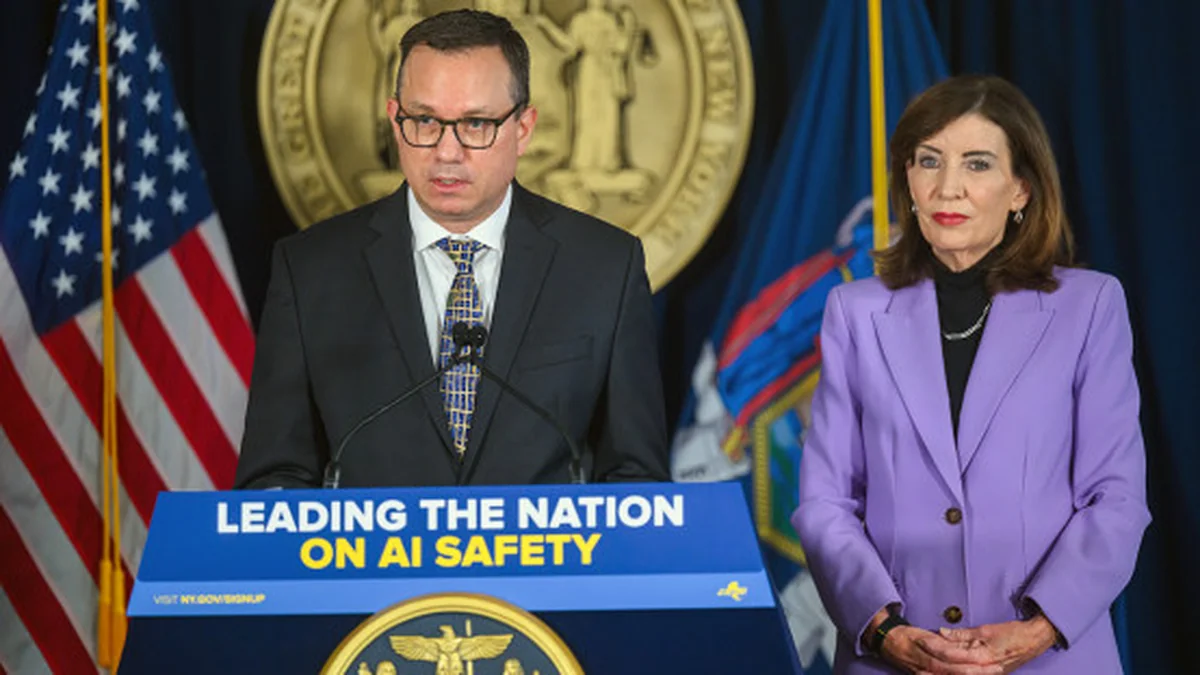
This closed loop of internal safety assessments has created growing skepticism among academic researchers and policymakers who question whether private boardrooms can objectively audit their own systems. On November 10, 2026, New York Governor Kathy Hochul countered that dynamic by launching the New York Center for AI Responsibility and Research, known as NYCAIRR, based at Binghamton University. The statewide initiative establishes a dedicated technical infrastructure dedicated to independent evaluations of advanced artificial intelligence models outside corporate influence.
According to an official dispatch from the New York State Department of Financial Services, Governor Hochul stated that “The stakes are too high to simply take AI companies at their word.”
By anchoring the initiative to public supercomputing resources and enforceable regulatory standards, the state is testing whether academic institutions can break corporate oversight monopolies. The effort represents the first comprehensive attempt by a U.S. state to build technical verification capabilities that operate independently of federal agencies and commercial vendors.
The Academic Counterbalance to Silicon Valley's Safety Conundrum
To direct the scientific agenda, the state appointed two prominent computer scientists as interim co-directors: Greg Morrisett, the Jack and Rilla Neafsey Dean and Vice Provost of Cornell Tech, and Jeannette Wing, Executive Vice President for Research at Columbia University. Both researchers have spent decades investigating formal verification, system reliability, and software security across distributed computing environments. Their mandate involves organizing a distributed statewide network of more than 80 researchers from universities across New York, allowing scientists to conduct independent safety research while remaining anchored at their home faculties.
In an interview published by the Cornell Chronicle, Morrisett observed that commercial labs operate under structural market pressures where “safety is one priority among many.”
That observation illustrates the core institutional tension governing contemporary frontier model deployment. While commercial engineering teams invest heavily in safety research, their findings remain subordinate to quarterly enterprise launches and product roadmap commitments. NYCAIRR establishes an alternative operating posture by dedicating its entire operational capacity exclusively to safety benchmarks, mathematical boundaries, and vulnerability discovery without commercial commercialization targets.
The initial scientific agenda concentrates on foundational limits, agentic tool-use safety, and hardware security across complex machine learning architectures. Rather than relying on sporadic external bug bounties, the academic network establishes a continuous testing environment to evaluate systemic failure modes across deployed architectures.
Supercomputing for the Public Good: The $500 Million Architecture Behind Empire AI
Independent academic research has long faced a structural compute barrier when attempting to audit frontier machine learning systems. Academic computer science departments rarely possess the hardware clusters required to run inference on hundred-billion-parameter networks or simulate complex multi-agent environments at scale. As commercial labs expanded their computing clusters through circular capital arrangements, university researchers found themselves relegated to black-box web interfaces.
To bridge that technical disparity, NYCAIRR will directly leverage the processing capacity of Empire AI, a $500 million public-private supercomputing initiative established by New York State.
The supercomputing cluster provides state institutions with dedicated compute power specifically reserved for public-good scientific research. NYCAIRR itself was established following a $30 million philanthropic gift from a donor group led by Binghamton alumnus and Bloomberg LP co-founder Tom Secunda. That private contribution was paired with an initial $25 million research capital investment from the State University of New York alongside ongoing operating capital from the state budget. Secunda noted during the launch that advancing public safety requires ensuring that powerful machine learning tools remain “grounded in rigorous science.”
Compute parity allows academic researchers to run independent benchmark suites without relying on rate-limited commercial application programming interfaces. This high-performance hardware backing transforms academic oversight from theoretical commentary into empirical, reproducible stress-testing.
Institutional Separation: How DIGIT and NYCAIRR Divide Enforcement from Science
The structural design of New York's framework deliberately separates regulatory policing from scientific evaluation. Rather than granting researchers prosecutorial authority or tasking civil servants with code verification, the state split administrative enforcement from laboratory testing. Regulatory execution resides within the Department of Financial Services under its newly established Office of Digital Innovation, Governance, Integrity, and Trust, designated as DIGIT.
DIGIT officially opened its administrative intake channel under the state's Responsible AI Safety and Education Act, known as the RAISE Act.
Under the statutory provisions of the RAISE Act, large frontier artificial intelligence developers operating within New York must register through the state portal by January 1, 2027. Registered developers are legally required to publish detailed safety frameworks and submit quarterly high-severity risk assessments. Furthermore, developers face an explicit statutory mandate requiring them to report any critical safety incident to DIGIT within 72 hours of discovery.
Within this administrative architecture, NYCAIRR functions as an external technical advisory body rather than an enforcement agency. The center will evaluate developers' published safety frameworks and deliver technical recommendations directly to state regulators, providing objective scientific data to guide policy decisions.
Regulatory Federalism Versus International AI Governance
New York's initiative reflects a broader structural reality of American artificial intelligence policy: regulatory federalism filling a federal void. While the United States Congress remains stalled on comprehensive statutory frameworks, state governments are deploying existing regulatory bodies to impose mandatory compliance standards. California attempted a comprehensive legislative path through contested statutory drafts, but New York utilized statutory supervisory powers through financial oversight agencies. This state-level mobilization mirrors historical patterns in financial services and consumer privacy, where New York regulations established national corporate standards.
International governance models demonstrate distinctly different structural approaches to the verification problem.
The European Union established a centralized, top-down enforcement mechanism through the EU AI Act, which categorizes frontier architectures by compute thresholds and imposes strict pre-market technical documentation rules. In contrast, the United Kingdom founded its government-backed AI Safety Institute to conduct voluntary pre-deployment testing in close collaboration with domestic developers. New York combines elements of both philosophies: mandatory registration and incident reporting under the RAISE Act, supported by independent academic evaluation through NYCAIRR.
This hybrid structure tests whether regional financial jurisdictions can enforce accountability across multinational tech conglomerates. If large developers comply with New York's reporting rules to maintain commercial standing in the state, the local framework will effectively function as a baseline standard across the broader domestic market.
The Epistemic Limits of External Red-Teaming on Closed Frontier Models
Despite its significant compute allocation, external academic evaluation confronts technical boundaries inherent to proprietary machine learning architectures. When commercial labs grant external access, that evaluation is frequently restricted to inference endpoints rather than complete access to model weights, training checkpoints, or raw reinforcement learning datasets. Behavioral probing through application programming interfaces can identify explicit alignment failures, but it struggles to guarantee mathematical bounds against latent vulnerabilities. Similar constraints have emerged in digital forensics, where evaluating sophisticated threats like deepfake verification methods requires examining raw data pipelines rather than relying solely on surface-level visual artifacts.
Assessing complex agentic systems that execute autonomous code introduces verification challenges that extend far beyond standard benchmark datasets.
When models interact with external tools, execute multi-step planning, or interface with legacy databases, deterministic safety guarantees become mathematically intractable. Researchers at NYCAIRR plan to address these vulnerabilities by recruiting national specialists in formal methods, mathematical limits, and interpretability. Their objective centers on developing novel measurement instruments capable of evaluating how autonomous systems behave under adversarial stress. However, without mandatory disclosure of model weights, academic evaluation remains fundamentally an empirical stress-test rather than an exhaustive audit.
The effectiveness of the consortium will largely depend on whether future statutory updates grant researchers deeper inspection rights. Until those legal parameters expand, NYCAIRR operates at the outer boundary of empirical black-box testing.
Concrete Baselines for Independent Systemic Verification
The operational test of New York's model begins as statutory compliance deadlines arrive throughout the coming year. Large frontier developers have until January 1, 2027, to complete mandatory registration on the RAISE portal and publish their operational safety frameworks. As those public disclosures appear, NYCAIRR will begin analyzing corporate claims against empirical test results generated across the Empire AI supercomputing cluster.
State officials will then evaluate whether developer disclosures align with independent laboratory findings or reflect corporate public relations messaging.
By establishing a dedicated research network backed by $500 million in supercomputing resources and legal reporting mandates, New York has altered the institutional dynamics of technology governance. The initiative demonstrates that evaluating the risks of advanced artificial intelligence no longer remains the exclusive domain of commercial laboratories.

Written by Adriano Nascentes
Founder & Lead AI Systems Analyst · Verified Staff
Founder and editor-in-chief of Unknown Observer. Technology researcher and software engineer investigating foundation models, autonomous agent runtimes, cognitive architectures, and frontier AI safety.
Was this article helpful?
Your feedback helps our editorial team refine reporting depth and accuracy.