Tencent Hy4 Flash Shifts AI Focus to Task Economics
Tencent launched Hy4 Flash, cutting inference cost per task by 95% in internal benchmarks while matching Claude Haiku satisfaction at one-eighteenth the price.
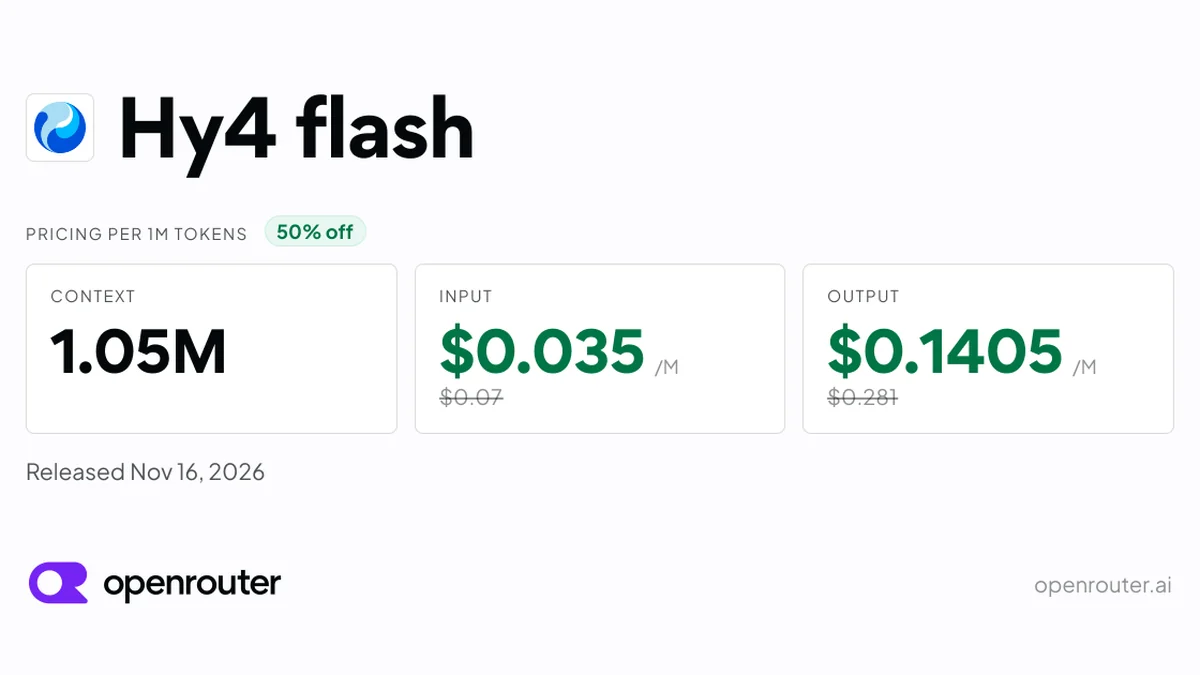
Tencent officially launched the Hy4 Flash model on November 16, 2026, targeting high-speed execution for routine computational workflows. The release signals an operational transition in artificial intelligence deployment, where infrastructure cost per task increasingly supersedes raw parameter scale as the primary competitive metric for enterprise systems.
Rather than pursuing incremental accuracy gains on complex academic benchmarks, software providers are confronting the realities of enterprise inference budgets. Deploying monolithic foundation models across recurring operational pipelines imposes severe computational overhead on corporate balance sheets. Tencent designed Hy4 Flash to address this margin friction, offering high-throughput processing for data extraction, document processing, and autonomous agent loops.
Architecture and the Mechanics of Sparse Activation
The system relies on a Latent Mixture-of-Experts architecture containing 224 billion total parameters while activating only 12 billion per forward pass.
This sparse routing mechanism operates alongside Hybrid Attention and Engram memory modules, delivering an active context window of up to 1 million tokens. Internal technical benchmarks report decoding speeds exceeding 150 tokens per second across standard server configurations. The combined architecture enables rapid token generation without necessitating massive memory footprints on host accelerators. By maintaining low active parameter density, the infrastructure avoids excessive thermal and power penalties during sustained query bursts across high-density data centers.
Economic metrics documented in Tencent's proprietary WorkIndex benchmark illustrate the mechanical impact of this sparse design. The benchmark, which measures task execution expenses across administrative enterprise workflows, recorded a cost of ¥ 0.20 per task for Hy4 Flash compared to ¥ 5.70 for the flagship Hy4 and ¥ 3.20 for the earlier Hy4 Preview. For software teams tracking recurring cloud compute outlays, this variation alters the baseline financial feasibility of continuous workflow processing.
WorkBuddy Blind Testing and the Claude Haiku 5.5 Comparison
This expenditure reduction of approximately 96.5% against the flagship system involves a measured engineering compromise. Hy4 Flash scored 42.1 points on the WorkIndex evaluation, trailing the primary Hy4 benchmark score of 51.4 points. The design demonstrates that reducing execution costs by more than an order of magnitude does not require matching frontier reasoning depth across every production pipeline.
Comparative data from controlled workplace evaluations expands on these comparative dynamics.
Tencent conducted a double-blind trial across its WorkBuddy productivity platform, examining 259 distinct administrative tasks across 27 operational categories evaluated by 85 internal enterprise users. The assessment tested Hy4 Flash against leading small-footprint commercial models to benchmark perceived output quality against operational expenditure. DeepSeek V4.1 Flash led the evaluation with an average user satisfaction score of 3.09 at ¥ 1.20 per task. Anthropic's Claude Haiku 5.5 registered a score of 2.81, incurring an average cost of ¥ 4.73 per task.
Hy4 Flash achieved a nearly identical satisfaction score of 2.79, while executing tasks at ¥ 0.26. GLM-5.3 Flash trailed the group with 2.53 points at ¥ 0.81 per task. In high-volume corporate departments where repetitive drafting and form summarization dominate daily traffic, fractional differences in subjective satisfaction rarely justify an eighteen-fold cost premium.
API Unit Economics and Autonomous Agent Scaling
The statistical proximity between Hy4 Flash and Claude Haiku 5.5 illustrates a significant economic variance for production environments. Delivering comparable subjective satisfaction while running at roughly one-eighteenth the per-task cost alters deployment feasibility for multi-step agent architectures. However, the data also highlights technical boundaries, as DeepSeek maintained a distinct satisfaction lead that illustrates the persistence of qualitative differences across more demanding compositional assignments.
Official commercial pricing reflects this aggressive commodity positioning.
Tencent set standard API rates at $0.070 per million input tokens and $0.281 per million output tokens, with cached context priced at $0.003 per million tokens. These baseline rates are now listed across multi-provider routing platforms, including <a href="https://openrouter.ai/tencent/hy4-flash" target="_blank" rel="noopener noreferrer">OpenRouter</a>, expanding integration access for software engineering teams. Autonomous workflows completing deep web retrieval, structured parsing, and transactional validation frequently issue dozens of model invocations per user session. Under frontier model pricing, recurring operational loops render autonomous services commercially unsustainable without heavy venture subsidization.
Enterprise Tiering and the Shift in Procurement Priorities
Lightweight, low-latency models enable recursive agent routines to operate continuously without consuming disproportionate infrastructure budgets. Similar architectural shifts toward tiered orchestration were highlighted in analyses of <a href="/posts/gemini-4-hydrogen-google-model-orchestration-efficiency">multi-model task economics</a> and <a href="/posts/google-teamwork-gemini-courtade-kumar-conjecture-proof">verification workflows</a>. When engineering organizations implement automated routing, assigning compact models to preliminary filtering preserves expensive reasoning budgets for verified edge cases.
Several critical caveats temper these initial performance disclosures. All cost and satisfaction figures originate from Tencent's internal benchmark suites and employee trials, lacking independent third-party verification. Furthermore, while Tencent signaled intentions to release model weights, open-weights availability remains unconfirmed on public model repositories. The absence of external replication means enterprise evaluators must treat published efficiency gains as provisional operational indicators rather than audited industry standards.
Commercial adoption will depend on whether independent developer workloads replicate the latency and cost advantages reported in controlled enterprise environments.
Software organizations are restructuring inference pipelines around tiered model orchestration. As foundational model providers expand their compact tiers, enterprise purchasing decisions will increasingly prioritize task unit economics over public leaderboard rankings.

Written by Adriano Nascentes
Founder & Lead AI Systems Analyst · Verified Staff
Founder and editor-in-chief of Unknown Observer. Technology researcher and software engineer investigating foundation models, autonomous agent runtimes, cognitive architectures, and frontier AI safety.
Was this article helpful?
Your feedback helps our editorial team refine reporting depth and accuracy.