Claude Meetings Moves AI From Call Notes to Live Execution
Anthropic's Claude Meetings shifts AI from call recaps to live Google Meet tasks, raising sharp questions about ownership, consent, and rollout clarity.
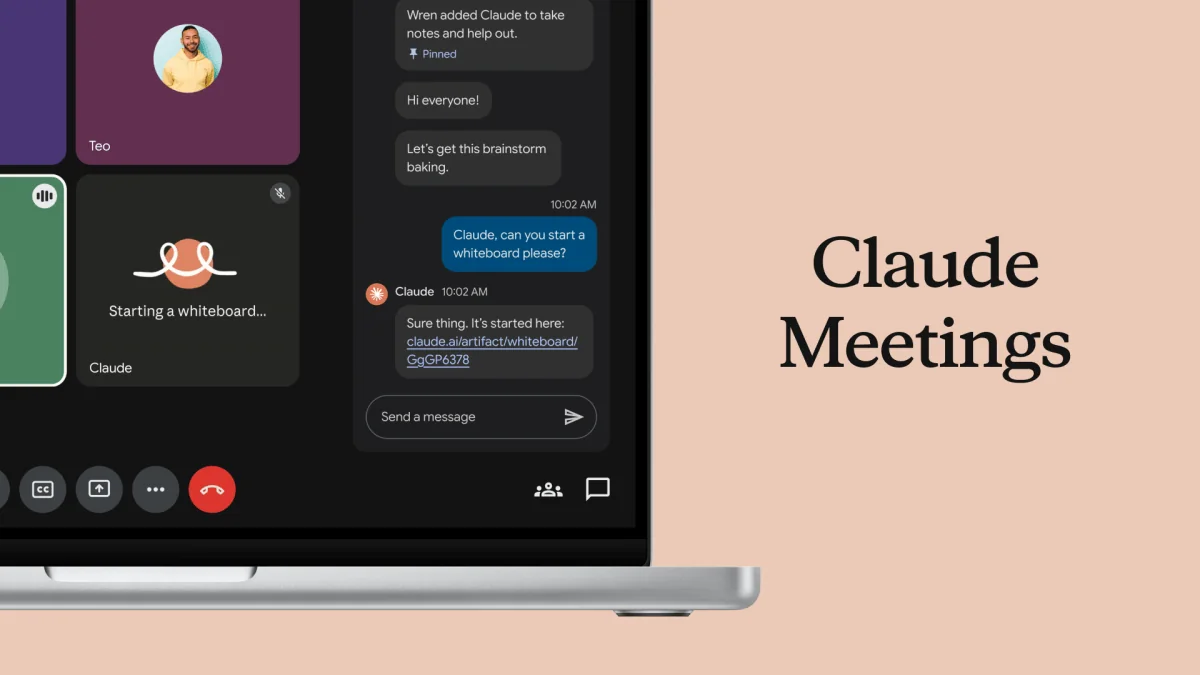
On November 10, 2026, Anthropic introduced Claude Meetings as part of a broader productivity push that places its assistant in live Google Meet video calls. Rather than summarizing a transcript after participants disconnect, the software joins as a visible attendee capable of answering chat questions, querying connected apps, and drafting plans while the discussion is still underway.
That shift changes the operational center of gravity in corporate meetings. Recording tools and post-call recap assistants leave human participants in charge of translating conversation into deliverables once a call wraps up. When an agent starts building timelines, retrieving internal figures, and organizing action items in real time, organizations face an immediate question over who owns the accuracy and commitments embedded in those live artifacts.
Inside Claude Meetings and the November 10 Rollout Discrepancy
As detailed by TechCrunch, Claude Meetings enters a Google Meet call as an identifiable attendee and posts a visible notice in the meeting chat.
Once in the room, the assistant tracks spoken dialogue and responds to direct prompts in the chat window. Participants can instruct it to pull historical figures from connected enterprise applications, map a project timeline onto a digital whiteboard, or draft a working plan before the call adjourns. After the session ends, all notes, action items, and generated materials remain available in claude.ai for follow-up editing. Anthropic also built automated guest boundaries into the workflow, blocking Claude from joining calls with external visitors unless an administrator authorizes entry and forcing it to exit immediately if an unapproved external guest joins.
Operational autonomy remains constrained in this initial release, even though the tool works concurrently with human speech. According to Computerworld, citing an Axios interview with Anthropic product leader Nicholas Lin, Claude Meetings currently waits for user instructions rather than acting independently, though the firm expects it could become "more proactive" over time.
Documentation published on launch day also exposes an unresolved gap between press reports and Anthropic's own marketing copy. TechCrunch reported on November 10 that Claude Meetings was launching in beta for Team and Enterprise accounts on Google Meet, and Computerworld added on November 11 that the tool is enabled by default for Claude Team subscribers while remaining unavailable on competing video platforms. Yet Anthropic's November 10 announcement still describes the capability twice in future tense, stating that "Claude Meetings is coming soon" without clarifying whether every eligible workspace already has live availability.
Connecting Calls to Whiteboards, Sheets, Data, and Embedded Apps
Anthropic did not release meeting participation as a standalone add-on. The capability sits at the front end of a November 10 suite update that introduces Claude Whiteboards and Claude Sheets in beta across paid plans while promoting Claude Data, previously named Claude Dashboards, to general availability.
Each surface handles a distinct stage of turning rough conversation into structured office output. Claude Whiteboards converts spoken brainstorming into collaborative boards containing timelines, task owners, and due dates, and Team or Enterprise users can run those boards live in a Google Meet session. From there, teams can carry context into Claude Sheets for multi-tab spreadsheets with formulas and cell-level change tracking, or into Claude Data to assemble dashboards and narrated data stories from warehouses and customer systems like Snowflake and Salesforce.
Interactive connectors built on the Model Context Protocol link that workspace to external software.
Anthropic states that Claude Marketplace now lists more than 9,000 connectors and plugins, and the updated interactive layer embeds full partner applications from Adobe, Atlassian, Box, and Notion alongside Claude conversations rather than forcing users to switch browser tabs. Plugins for Salesforce in beta, NetSuite, and Workday in beta package domain skills for sales call preparation, financial analysis, and human-resources requests. Among Anthropic's own staff, non-engineering teams have built comparable internal workflows, with the vendor reporting that a Slack-based legal tool cut marketing review turnaround from three days to 24 hours and its finance group converted an executive statement into a collaborative page. Metrigy principal analyst Irwin Lazar told Computerworld that giving Claude native entry to meeting context avoids manual copy-pasting or paying extra fees for MCP connectivity, which video vendors such as Zoom now charge for, though he doubted Anthropic will build competing email, calling, or video-conferencing infrastructure of its own.
How Gemini in Meet and Copilot in Teams Draw Different Boundaries
Automated meeting assistance already exists in major workplace suites, so Anthropic's pitch competes on architecture rather than novelty. Google Meet, Microsoft Teams, Zoom My Notes, Webex, Otter, and Granola already capture calls and generate structured follow-ups.
Google's official Meet Help documentation for its "Take notes for me" tool illustrates a document-centric model built around post-call synthesis in Google Docs. Gemini captures summaries, lists assigned next steps, includes slides shown on screen for at least 10 seconds, and categorizes decisions under explicit statuses labeled Aligned, Needs Further Discussions, Disagreed, or Shelved, while letting late joiners read a mid-call recap. Administrators can require explicit member permission prior to recording, display custom policy banners in the pre-join screen, or let internal employees hit Quick Stop when sensitive topics arise.
Microsoft takes a more compartmentalized path with Microsoft 365 Copilot inside Teams, according to Microsoft Support documentation. Unlike an open participant in the room, Copilot opens in a private chat pane where individuals query the live transcript or chat, then export tables to Excel or drafts exceeding 1,300 characters to Word unless sensitivity labels block copying, under organizer controls set to during-and-after, during-only, or off.
Claude Meetings diverges from both incumbents by placing artifact creation in the group call flow, even as rival AI labs chase similar territory. TechCrunch notes that OpenAI recently introduced workplace tools inside ChatGPT for company data visualization and presentation assembly, while Meta unveiled its Muse AI agent to build task-specific mini-apps on demand. As The Collab Collective chief analyst Craig Durr observed in Computerworld, Anthropic is attempting to move Claude from a destination for isolated questions to an active environment where teams perform live work.
Consent, Legal Friction, and Shared Accountability Inside Automated Calls
Placing an active AI worker in synchronous meetings shifts corporate governance away from simple transcription rules toward joint operational accountability. When an employee asks Claude to log action items, draft a timeline, or edit a connected record mid-call, any misheard nuance or premature task assignment can harden into an authoritative record in claude.ai before team members review it. Durr cautioned in Computerworld that recording and consent laws vary across jurisdictions and company policies, recommending that IT, legal, and human-resources leaders establish formal rules before enabling the tool.
Anthropic pairs the rollout with technical isolation controls, encrypting commercial data in transit and at rest while running each new Enterprise cloud session in an isolated virtual machine that keeps connector credentials outside the sandbox. Administrators can inspect usage through audit logs and a Compliance API spanning over 100 security tools including Splunk and CrowdStrike, and restrict individual connectors to read-only actions such as reading Slack without posting messages.
Those perimeter safeguards govern technical permissions, yet they do not settle how teams approve or dispute work generated on the fly during open conversation.
Durr's warning in Computerworld highlights why proactive behavior changes the equation for corporate governance. Until Anthropic resolves the conflict between its "coming soon" announcement page and reports of default Team beta activation, and until organizations align jurisdictional consent rules with live task execution, human attendees remain responsible for verifying every plan and deliverable Claude writes during a call.

Written by Adriano Nascentes
Founder & Lead AI Systems Analyst · Verified Staff
Founder and editor-in-chief of Unknown Observer. Technology researcher and software engineer investigating foundation models, autonomous agent runtimes, cognitive architectures, and frontier AI safety.
Was this article helpful?
Your feedback helps our editorial team refine reporting depth and accuracy.